
Home » Singapore National Hydrogen Strategy: What an Import-Dependent Hub Is Building
Singapore National Hydrogen Strategy: What an Import-Dependent Hub Is Building
10 min read · Dec 2, 2025 · By Alex
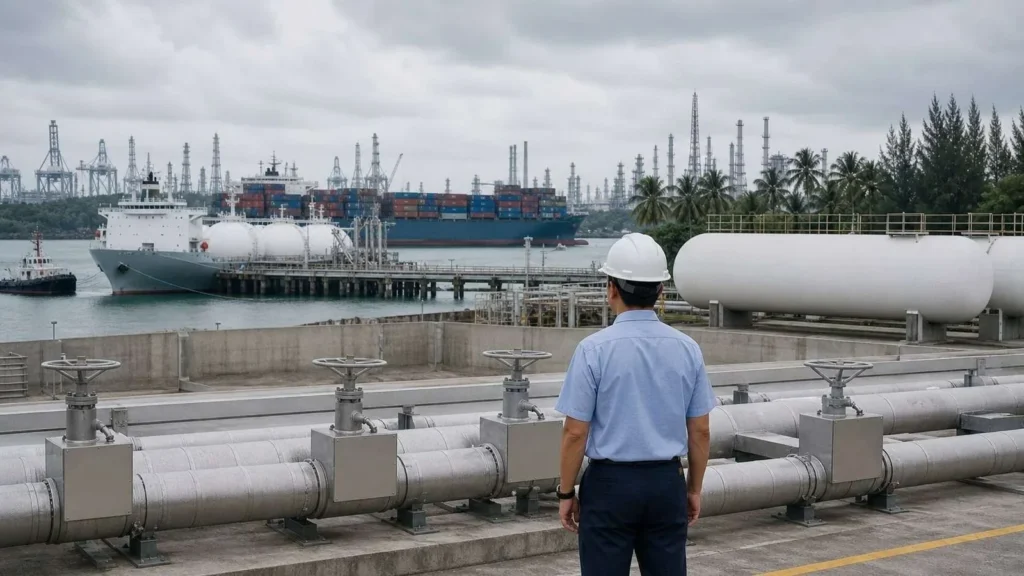
Singapore published its national hydrogen plan in October 2022. The plan assesses that hydrogen could supply up to 50 percent of projected electricity demand by 2050. The country buys none of it today. I cover this corner of hydrogen, power-to-liquid and e-fuels for developers who need demand rather than slogans, and what I find is an import and capability plan, paced against technological progress, not a tender. The Singapore hydrogen strategy sets a destination and a list of capabilities, then deliberately leaves the purchase order blank. That gap is where the selling work begins.
I order the article in four moves: what the strategy claims, what sits behind the claim, what the region already buys, and what I verify before I sell into it. Every figure below carries its date, because an undated projection is indistinguishable from a slogan.
In short
- Claim: Hydrogen could supply up to 50 percent of projected electricity demand in 2050, assessed in October 2022, with the fuel mix explicitly left open.
- Status: An import and capability plan. It buys nothing and runs no tender (2022).
- Port: The world’s largest bunkering hub, close to 50 million tonnes of marine bunker fuel supplied in 2021.
- Region: 12 percent of a 4 Mt regional demand in 2024, with 6 percent of announced capacity at final investment decision (2025).
- Contract: Firm purchase agreements worldwide cumulate to less than 2 Mtpa, 5 percent of the production potential announced for 2030 (2025).
In this article
What the strategy is and when it was written
The plan I am reading was published in October 2022 by the national trade and industry ministry, inside a national frame of net zero by 2050 (2022). It is a positioning paper, not a procurement notice. The timing matters: 40 countries had announced hydrogen strategies in 2022, and the pipeline was doing the talking. If every announced project materialised, low-carbon hydrogen production could reach up to 24 Mtpa by 2030, against less than 1 Mtpa in 2021 (2022). Four terms from the document govern my conversations with sellers. A pathfinder project is an early build meant to test a technology and an operating model before full-scale deployment.
Also, a guarantee of origin is a record of where and how a kilogram of hydrogen was produced. A bunkering hub is a port where ships refuel. In addition, a firm purchase agreement is a binding commitment to buy a stated volume over a stated period.
What this means for you: I am reading a vocabulary and a date, not a tender calendar. Ask what a pathfinder project means for volumes in the first years.
The claim that matters
Singapore’s National Hydrogen Strategy of October 2022 assesses that hydrogen could supply up to 50 percent of projected electricity demand by 2050. Behind that sentence sit three constraints it states plainly. Power accounted for 39.8 percent of primary emissions in 2020, out of a total of 49.7 MtCO2e (2022). Solar has a technical ceiling of about 8.6 GWc. That covers roughly 10 percent of projected electricity demand in 2050 (2022). Electricity imports could cover about 30 percent of projected demand by 2035 (2022). Combined cycle gas turbines able to run fully on hydrogen are expected around 2030 (2022). In addition, the plan says the final fuel mix is not fixed. This is the frame I use for how capital is actually moving across the region, because a share of future demand is not an order book.
What this means for you: treat 50 percent as an analytical ceiling for 2050, not a procurement target for this year. The plan fixes no fuel mix and signs no volume, so I ask every seller which of these constraints they are solving.
What the port already buys
Singapore is the world’s busiest container transhipment port, with ship arrival tonnage above 2.8 billion gross tonnage in 2021. It is also the world’s largest bunkering hub, with close to 50 million tonnes of marine bunker fuel in 2021 (2022). Fuel is the demand I can already see. Ammonia and hydrogen used onboard could be available before the end of the decade (2022). Ammonia could also meet 45 percent of international shipping fuel demand on the path to net zero in 2050 (2022). The port authority is studying ammonia as a bunkering fuel, setting safety envelopes and a regulatory sandbox (2022). By 2050, container handling equipment is to be electrified.
In addition, every harbour craft to run on full electric propulsion or zero emission fuels (2022). The shipping side of marine fuel transitions is where I see physical offtake volume first.
What this means for you: this is the one place where Singapore already has fuel volume, a schedule and a regulator. I bring ammonia and hydrogen suppliers here first, because a bunkering hub buys molecules in bulk long before a power project does.
The neighbour's demand
Malaysia’s Hydrogen Economy and Technology Roadmap of 5 October 2023 sizes the market this plan is aimed at. It puts Singapore’s own hydrogen demand at 0.3 MTPA in 2030 rising to 1 MTPA in 2050 (2023). The same table sets Japan at 3 MTPA in 2030, rising to 20 MTPA in 2050. It sets South Korea at 2 MTPA, rising to 11 MTPA (2023). I read the four rows together: Singapore is a small, late, specification-driven import market sitting next to much larger buyers (2023). The strategy never claims to be the region’s biggest buyer. In addition, the roadmap of the neighbour does not treat it as one. What Singapore offers instead is a port, a regulatory capability and a route to certification that a first shipment needs.
Also, What this means for you: I price this market on contract terms and delivery conditions rather than on tonnage. A seller who leads with scale loses to the buyer in Japan; a seller who leads with guarantee of origin, specification and berth access gets the meeting.
How Singapore sequences it
The plan is organised around five thrusts: pathfinder projects, research and development, international collaboration, long-term land and infrastructure planning, and workforce training (2022). Deployment and infrastructure are paced against technological progress and global progress, which means capability first and volume later (2022). Aviation follows the same logic. ICAO set a long-term goal of net zero carbon emissions by 2050 for international aviation at its September and October 2022 assembly. Sustainable aviation fuels should play the largest role (2022). At the airport, a first blended sustainable aviation fuel uplift happened in July 2022, and from 2023 the country hosts the world’s largest sustainable aviation fuel production plant with an annual capacity of 1 million tonnes (2022).
In February 2022 the civil aviation authority signed a cooperation agreement on hydrogen supply and infrastructure with an aircraft maker, the airport group and an industrial gas company (2022). I set this sequence against the international maritime framework, rule by rule.
What this means for you: Singapore buys capability before it buys tonnes, so I sell into the pilot and the training phase first, then into the volume contract.
What the region proves
The IEA Global Hydrogen Review 2025 briefing for Southeast Asia of 9 December 2025 gives the demand picture the plan sits inside. Regional hydrogen demand was 4 Mt in 2024, and Singapore accounted for 12 percent of it (2025). Announced regional projects equal 12 percent of current demand, with only 6 percent of announced capacity at final investment decision (2025). Close to 11 Mtpa of regional potential sits below 6 USD/kg by 2030, largely in Indonesia (2025). No certification scheme is in place in the region, though work is under way in three countries (2025). High capital cost is the main barrier (2025). I run every supplier in ammonia offtake across Southeast Asia through this record before I count Singapore.
What this means for you: before I count Singapore at all, I ask whether the seller holds a certification route, whether the project has taken its final investment decision, and whether the delivered cost survives the regional price band. Without all three, the share is arithmetic rather than demand.
What the strategy does not buy
The IEA page of five key questions about hydrogen, 2025, records the gap between announcement and commitment. Firm purchase agreements cumulate to less than 2 Mtpa worldwide. That is only 5 percent of the production potential announced for 2030 (2025). 9 percent of announced projects worldwide have secured committed investment, against 0.5 percent in emerging economies (2025). The cost of capital reaches 15 percent in emerging economies, three times the level in advanced economies (2025). Nothing in Singapore’s plan changes those three numbers: a capability programme does not convert into signed volume by itself. Committed investment is not money spent, and an announced offtake is not a contract. That is the honest reading of an import-dependent hub that has chosen to build skill before it signs.
What this means for you: I do not let a national plan stand in for a buyer. I ask which of the announced projects has committed money, who carries the capital cost, and whether a firm purchase agreement exists before I count any tonnage in Singapore.
What I verify before selling into it
The Oxford Institute for Energy Studies study Hydrogen Offtake Agreements of August 2025 gives me the contract benchmark I check every proposal against. Hydrogen sale and purchase agreements typically run 10 to 15 years. That is about half the length of the first international gas and LNG contracts (2025). Volume provisions sit at take-or-pay of 60 to 80 percent, against above 90 percent in gas and LNG (2025). Take-or-pay means the buyer pays a set share of the annual contract quantity.
The volume agreed for delivery in a year, even when it does not take the molecule. Emissions intensity is the greenhouse gas released per unit of hydrogen produced. Together with certification schemes, it decides commercial value and access to support regimes (2025). Guarantee of origin methodologies and emissions intensity standards are critical for international trade. I check it when I structure an offtake negotiation, before a seller counts Singapore as revenue.
What this means for you: I read the contract term, the volume floor. In addition, the emissions clause together, because that is where an import-dependent buyer protects itself. A seller who negotiates only price has not started.
Sources
- Ministry of Trade and Industry Singapore, Singapore’s National Hydrogen Strategy, October 2022 https://isomer-user-content.by.gov.sg/1004/d39b6777-d0c6-4758-93fb-4e4fa3694f22/ebrochure_HPO_Oct_26.pdf, 2022.
- IEA, Global Hydrogen Review 2025, Southeast Asia, 9 December 2025 https://iea.blob.core.windows.net/assets/745a259b-9cb7-4e1d-9ba1-a8b63d1eaae8/GHR2025_SEA_Webinar.pdf, 2025.
- Also, IEA, Global Hydrogen Review 2025, Five key questions about hydrogen https://www.iea.org/reports/global-hydrogen-review-2025/five-key-questions-about-hydrogen, 2025.
- Oxford Institute for Energy Studies, Hydrogen Offtake Agreements https://www.oxfordenergy.org/wpcms/wp-content/uploads/2025/08/ET50-Hydrogen-Offtake-Agreements.pdf, August 2025.
- Malaysia, Hydrogen Economy and Technology Roadmap, 5 October 2023 https://www.mosti.gov.my/wp-content/uploads/repository/penerbitan/2023/Hidrogen%20Economy%20&%20Technology%20Roadmap.pdf, 2023.
Frequently asked questions
What is Singapore's hydrogen strategy?
A national plan published in October 2022 around five thrusts: pathfinder projects, research and development, international collaboration, long-term land and infrastructure planning, and workforce training (2022). It sits inside a national frame of net zero by 2050 and treats hydrogen as an import question (2022). I read it as a capability document first and a demand document second.
How much hydrogen will Singapore need?
The plan assesses hydrogen at up to 50 percent of projected electricity demand in 2050 (2022), while the regional record of 2023 puts the country at 0.3 MTPA in 2030 rising to 1 MTPA in 2050. The second figure is the one I take into a commercial conversation, because it is a volume rather than a share of a future power mix.
Does Singapore buy hydrogen today?
Not as a buyer. The plan paces deployment and infrastructure against technological progress and global progress, and it builds capability first through pathfinder projects, research and development, and workforce training (2022). What exists today is preparation: studies, safety envelopes, a first fuel uplift and cooperation agreements on supply, none of which is a firm purchase agreement (2022).
What should I check before counting Singapore as a market?
Two things: certification and firm volumes. No certification scheme is in place in the region, with work under way in three countries (2025), and firm purchase agreements cumulate to less than 2 Mtpa worldwide (2025). I also check whether the project behind an offer has taken its final investment decision, since only 6 percent of announced regional capacity has (2025).
Not sure your project would survive a credit conversation?
A short call is usually enough to see where your project stands.
If you are mapping where policy money and mandated demand actually sit before you approach Singapore, I put the incentives, the grants and the regulatory conditions in one place: policy and incentive mapping. That is the file I hand to a seller who wants a market read rather than a brochure.
I do not provide investment advice or arrange investments. I act as a strategic advisor and facilitator.

Alex, Founder of WeConnect Asia
I help low-carbon fuel and carbon removal project developers in Southeast Asia secure the commercial and financial partners needed to reach FID.
Related articles

Pitching a Climate Tech Company to Strategic Investors: What the Corporate Has to Believe Before It Writes a Cheque
How to pitch a climate tech company to strategic investors: the metric cluster, the readiness evidence and the ask that corporates fund.

Biomethane: What It Is, How It Is Made and Who Buys It
Biomethane is biogas cleaned to pipeline quality. I explain how it is made, how it differs from biogas and who buys it in Southeast Asia.

CO2 Sourcing for e-SAF Projects: What the Rules Allow and What the Contract Must Say
Biogenic CO2, direct air capture or industrial flue gas: which sources an e-SAF plant may use, what they cost and which contract terms make the fuel certifiable.

Operating Performance Guarantees for SAF Plants: What Lenders Ask For
Minimum guarantees, performance damages, retesting and who stands behind them: the operating guarantees a SAF plant needs to keep debt and offtake intact.

EPC and Construction Risk in SAF Plants: What a Lender Actually Tests
FEED scope, convertible EPC, performance guarantees and damages caps: the construction risk questions a SAF project must answer before financial close.

Matching Feedstock and Offtake Risk Back-to-Back in a SAF Project: How Lenders Read the Chain
Lenders do not buy a feedstock plan and an offtake plan separately. They buy the link between the two, and the link is where most SAF files break.