
Home » Waste-to-X: Fuels and Chemicals from Waste, and What They Change for a Project
Waste-to-X: Fuels and Chemicals from Waste, and What They Change for a Project
10 min read · Mar 4, 2026 · By Alex
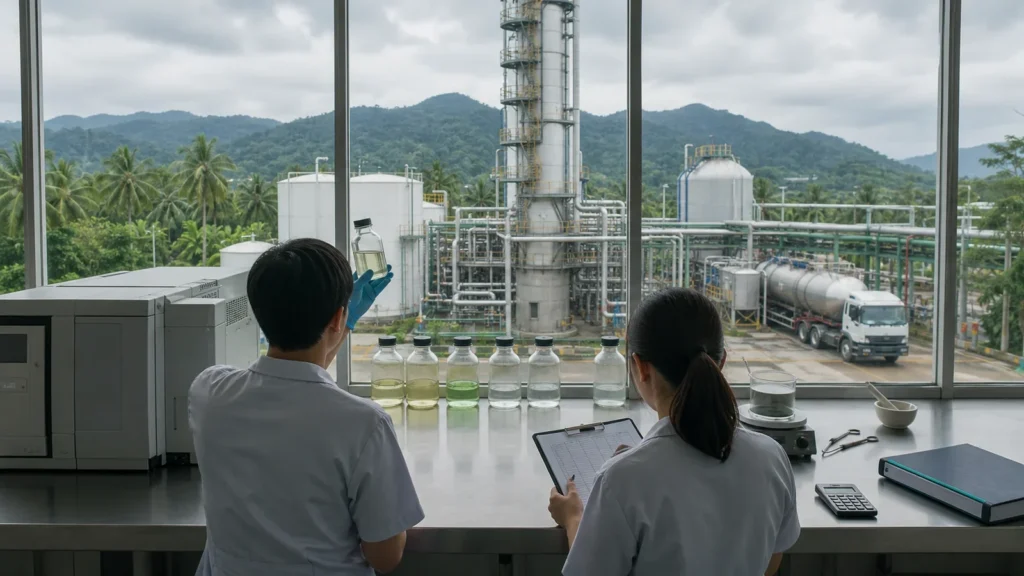
A power plant and a product plant start from the same waste-to-energy feedstock and part company at the reactor door. Going beyond electricity means sending the waste through pyrolysis, gasification or cement co-processing to obtain an oil, a synthetic gas or heat instead of power, and the choice is worth making on three measured things: a refuse-derived fuel that carries 8-20 MJ/kg, an optimised laboratory yield of up to 67.9 percent liquid oil, and a plant record where over 2 billion dollars of listed projects closed before starting operations. In waste to x terms, those three numbers set the frame for everything below, and the third is the one I keep in front of every route decision.
First I set out what the routes are and what each one returns, then what the record of these routes says, what I have to decide with the plant builder, what the regional streams already contain, how financing treats these outputs, what the contracts decide, and finally how I would stage the choice, in that order.
In short
- Routes: Pyrolysis, gasification and cement co-processing return an oil, a synthetic gas or heat instead of power, and refuse-derived fuel carries 8-20 MJ/kg in 2025 figures.
- Yields: An optimised laboratory process reaches up to 67.9 percent in weight of liquid oil and a synthetic gas up to 10.9 MJ/m3; neither is an operating result.
- Record: Projects carrying over 2 billion dollars, counted in March 2017, closed or were cancelled before starting operations.
- Feedstock: Waste composition governs the project, so a characterisation study has to cover every season over at least one year, wet and dry.
- Decision: I pick the route on measured calorific value, a signed buyer for the output and a permit path, in that order.
In this article
What beyond electricity actually means
Waste-to-X means every route that turns waste into a product rather than only into electricity, so a waste to x project parts company with a power project at the reactor door. The November 2025 review of thermochemical conversion of waste into energy sets out three: pyrolysis, gasification and incineration including cement kilns. Refuse-derived fuel, a solid fuel made from the combustible fraction of municipal waste, carries 8-20 MJ/kg with 8-40 percent moisture and 4-20 percent ash in 2025 figures, and calorific value means the energy released per kilogram of fuel. In the same 2025 review, an optimised pyrolysis reaches 67.9 percent in weight of liquid oil, a laboratory yield rather than an operating one, while gasification gives syngas, the synthetic gas produced by gasification, up to 10.9 MJ/m3. Co-processing means burning a fuel inside an existing cement kiln, replacing 50-60 percent of heat in rotary kilns and 80-100 percent in calciners in 2025 figures. Feedstock variability, tar and emission control are the limits, so I judge quality, technology choice, financial viability and environmental impact together. Municipal waste runs at 2.01 billion tonnes a year in 2025 figures, rising to 2.59 billion tonnes in 2030 and 3.40 billion tonnes in 2050.
What this means for you: I take the route on measured numbers, and treat any yield not yet repeated on a commercial line as a question to put to the builder.
What the record of these routes says
The March 2017 GAIA technology risk analysis counts over 2 billion dollars invested in the projects it lists, and every one closed or was cancelled before starting operations: Air Products and Chemicals, Thermoselect, Plasco, Compact Power, Caithness, Interserve and Brightstar. Other projects failed at the proposal stage after raising significant money, through community opposition and government scrutiny of false and exaggerated claims. Installations that did run missed their energy, revenue and emission targets and leaned on public subsidies. Waste gasification is classed as incineration under 2010/75/EU, article 3.40, and at 40 CFR 60.51a, as recorded in March 2017, with the process run generally above 600 degrees C. A 2008 study for a public body judged these processes unproven at commercial scale for mixed municipal waste, with residues that may be hazardous, a required pre-treatment and a higher cost than conventional incineration or landfilling. I set that record against circular work on industrial waste streams.
What this means for you: I read those failures as a due diligence list, and I ask any builder which of those failure modes their design already answers.
What has to be decided with the plant builder
The January 2025 Ramboll interview on developing waste-to-energy projects in Southeast Asia puts bankability at early pre-feasibility: a proven technical solution, an optimal risk allocation and a clear payment mechanism. It is literally garbage in, energy out, so the guarantee on waste composition governs the project, and I want a characterisation study covering every season for at least one year, wet and dry, with top-down and bottom-up sampling. One counterparty in front of the government finances more easily than split packages. Electricity demand in Southeast Asia is projected to grow 4 percent a year to 2035 against 3 percent for energy demand overall, and Thailand, in the January 2025 picture, gives a reinforced purchase tariff to plants under 10 megawatts. A plant in the Maldives, described in 2025, diverts about 200,000 tonnes a year from landfill, makes 100,000 MWh and avoids 200,000 tonnes of CO2, the emissions of 40,000 cars. I test those items with the plant guide first.
What this means for you: I bring the builder into the waste composition study and the payment mechanism at pre-feasibility, because that is where a fuel or chemical route becomes financeable or does not.
What the regional streams already contain
The July 2025 ISWA regional brief on waste management in Southeast Asia gives the tonnages I underwrite. Indonesia produced 35.8 million tonnes of municipal waste in 2022 at 0.67 kg per person; 47.64 percent went to sanitary or controlled landfill and 37.38 percent escaped into the environment. In the same July 2025 brief, Indonesia holds 12 waste-to-energy installations plus refuse-derived fuel units at Jakarta, Cilacap and Sidoarjo totalling about 1500 tonnes a day. Singapore treats about 80 percent of its municipal waste in waste-to-energy plants and produced 1502487 MWh from incineration in 2023. Thailand counted about 210 MW of installed capacity in 2018 against about 25.7 million tonnes of waste a year. The Philippines moved from 9.07 million tonnes in 2000 to 16.63 million in 2020 and projects 20.45 million by 2045. I map these streams in the Southeast Asia project finance page before I model revenue.
What this means for you: I match the route to a stream I can measure, not to a national total that nobody has characterised at the gate.
How financing treats these outputs
The June 2025 Asian Development Bank brochure on advancing the circular economy highlights the opportunity to extend circular economy investment in Asia and the Pacific. Its chain runs in three steps: upstream policy measures, then public and private investment and financing instruments downstream, then knowledge work and capacity development, all done with partners. Project 53068-001, listed in June 2025, covers plastic pollution from source to sea. My reading for a fuel or chemical route is blunt: the product has to sit at the end of a contracted chain, not beside it, so I name the buyer, the specification and the term before I fix the reactor. An offtake is the contract that takes the output of the plant, and I map the available structures in the offtake page for waste-to-energy and biogas. A route with no contracted end for its oil, gas or heat does not reach committee.
What this means for you: I would rather delay the reactor selection than discover after award that nothing signed will take the output.
What the contracts decide
Contracts, not chemistry, decide which route survives to close. In January 2025 the sector sized electricity demand growth at 4 percent a year to 2035, preferred one counterparty in front of the government and asked for at least one year of waste characterisation. In July 2025 one market alone counted 12 waste-to-energy installations and refuse-derived fuel units totalling about 1500 tonnes a day, which tells me what a tariff or a treatment fee has to cover. In March 2017 over 2 billion dollars of listed projects had closed before starting operations, so I read the payment mechanism before the process diagram. In November 2025 figures a refuse-derived fuel carries 8-20 MJ/kg and an optimised laboratory process reaches 67.9 percent in weight of liquid oil, which sets the specification I put into the contract. I write those terms in the guide to securing offtake.
What this means for you: I put the specification, the measurement method and the payment trigger in the same document, because a fuel contract with no measurement method is a price argument waiting to happen.
The five checks I run before I pick a route
I run these five in order, and I stop at the first one that fails.
- The measured calorific value and moisture of the delivered stream over a full year, since 8-20 MJ/kg and 8-40 percent moisture in 2025 figures set everything downstream.
- Whether the output has a buyer under a signed offtake, since the March 2017 count shows over 2 billion dollars closing before operations began.
- The permit route, because waste gasification sits inside incineration rules under 2010/75/EU and 40 CFR 60.51a, as recorded in March 2017.
- The residue handling, because the process leaves slag, fly ash and wastewater, and a 2008 assessment called those residues potentially hazardous.
- The subsidy or credit the model leans on and whether it survives a policy change, since the plants counted in March 2017 leaned on public subsidies to stay viable.
What this means for you: I sign off only when all five read clean on my own measurements, and I write the one that does not into the risk allocation.
How I would stage the route decision
I stage the decision against four dated points, and I do not move to the next until the previous one holds.
- 2008: the processes were judged unproven at commercial scale for mixed municipal waste, with residues that may be hazardous and a required pre-treatment.
- 2017: over 2 billion dollars of listed projects closed or were cancelled before starting operations.
- 2025: I commission the characterisation over one full year, set bankability at pre-feasibility, and label every laboratory yield as a laboratory yield.
- 2030: municipal waste is projected at 2.59 billion tonnes in 2030, and one national roadmap targets 100 percent recycled plastics that year.
What this means for you: I pick the route only after the 2025 row is complete on my own stream, because the 2030 row will not wait for a project that never reached operation.
Sources
- Quan et al., Thermochemical conversion of waste into energy: a review, 2025.
- GAIA, Waste Gasification and Pyrolysis: High Risk, Low Yield Processes for Waste Management, 2017.
- Ramboll, Garbage in, energy out: what you need to know when developing waste-to-energy projects in Southeast Asia, 2025.
- International Solid Waste Association, Regional Brief: Waste Management Challenges and Opportunities in South East Asia, 2025.
- Asian Development Bank, Advancing the Circular Economy: Creating a Sustainable Future in Asia and the Pacific, 2025.
Frequently asked questions
What does waste-to-X mean in practice?
It means sending the waste through pyrolysis, gasification or cement co-processing to obtain an oil, a synthetic gas or heat, instead of only generating electricity. An optimised laboratory process reaches up to 67.9 percent in weight of liquid oil, and a synthetic gas reaches up to 10.9 MJ/m3. Neither is an operating plant result, and both come from figures dated 2025.
Is a fuel route more bankable than a power route?
Neither is more bankable by default. What decides it is a proven technical solution, an optimal risk allocation and a clear payment mechanism, agreed at pre-feasibility rather than after the design is fixed. I add the guarantee on waste composition, because the process is literally garbage in, energy out, and the characterisation study should cover every season over at least one year.
Should I sell a chemical or a fuel?
On the buyer, not on the chemistry. The choice follows who signs the offtake, what calorific value the buyer demands, at 8-20 MJ/kg for refuse-derived fuel, and whether the contract covers the term of the debt. Where no buyer will commit for that term, I do not fix a reactor to that output.
What stops these projects at the proposal stage?
Three things: missing the energy, revenue and emission targets; reliance on public subsidies to stay viable; and community opposition plus government scrutiny of exaggerated claims, which killed projects after significant money had been raised. The published count of over 2 billion dollars in March 2017 covers projects that closed or were cancelled before starting operations.
Not sure your project would survive a credit conversation?
A short call is usually enough to see where your project stands.
If you want a second read on your stream, your route and your offtake before you commit, I do that work with you through strategic partnerships, starting from your own measurements and ending with a decision you can take to your builder and your lender. I keep the route choice, the permit path and the buyer conversation in the same room.
I do not provide investment advice or arrange investments. I act as a strategic advisor and facilitator.

Alex, Founder of WeConnect Asia
I help low-carbon fuel and carbon removal project developers in Southeast Asia secure the commercial and financial partners needed to reach FID.
Related articles

Pitching a Climate Tech Company to Strategic Investors: What the Corporate Has to Believe Before It Writes a Cheque
How to pitch a climate tech company to strategic investors: the metric cluster, the readiness evidence and the ask that corporates fund.

Biomethane: What It Is, How It Is Made and Who Buys It
Biomethane is biogas cleaned to pipeline quality. I explain how it is made, how it differs from biogas and who buys it in Southeast Asia.

CO2 Sourcing for e-SAF Projects: What the Rules Allow and What the Contract Must Say
Biogenic CO2, direct air capture or industrial flue gas: which sources an e-SAF plant may use, what they cost and which contract terms make the fuel certifiable.

Operating Performance Guarantees for SAF Plants: What Lenders Ask For
Minimum guarantees, performance damages, retesting and who stands behind them: the operating guarantees a SAF plant needs to keep debt and offtake intact.

EPC and Construction Risk in SAF Plants: What a Lender Actually Tests
FEED scope, convertible EPC, performance guarantees and damages caps: the construction risk questions a SAF project must answer before financial close.

Matching Feedstock and Offtake Risk Back-to-Back in a SAF Project: How Lenders Read the Chain
Lenders do not buy a feedstock plan and an offtake plan separately. They buy the link between the two, and the link is where most SAF files break.