
Home » EPC and Construction Risk in Waste-to-Energy: What the Contract Has to Absorb
EPC and Construction Risk in Waste-to-Energy: What the Contract Has to Absorb
10 min read · Feb 18, 2026 · By Alex
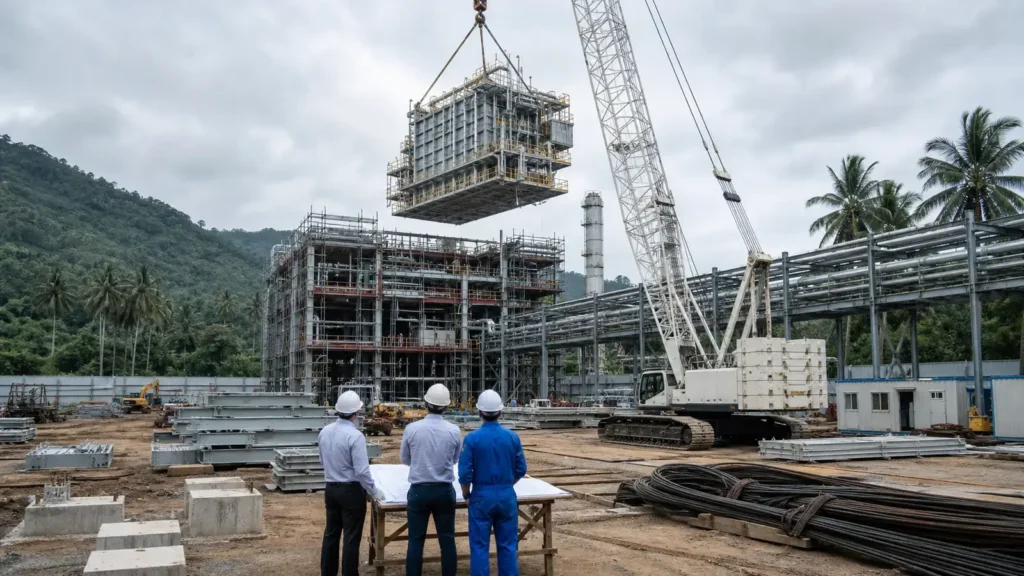
Construction risk on a waste-to-energy project is the risk that the plant costs more than the model assumed, finishes late, or fails to perform to specification. In a typical PPP contract the private partner carries it except for force majeure, compensation events such as unsurveyed site conditions, and material adverse government action, then passes it down through an EPC contract, the engineering, procurement and construction agreement with one contractor, written as a lump-sum contract at a fixed price for the whole works, secured by a performance bond, money held against failure to perform, and a parent company guarantee, the parent’s promise to answer for those obligations, with termination available if the longstop date, the outside date for completion, is missed. That is the shape of any waste to energy epc risk review I run at pre-FID. I read the five dated sources listed at the end and use no figure outside them, starting from the waste-to-energy industry page at the head of this silo.
Below I take the questions in order: what the contract has to absorb, why one contractor beats split packages, what a Southeast Asian file demands, what the ranking of risks says, and what a lender can take comfort in. Then I show how I check a package before signature.
In short
- Contract risk: overruns, delay and defects sit with the private partner except for force majeure, compensation events and government action, and pass down through a lump-sum contract.
- Single contractor: split packages are harder to finance because investors prefer one entity to a divided risk.
- Fuel first: a waste characterisation study covering all seasons for at least one year belongs before the contract.
- Ranking: in 2022, construction cost overrun and operation cost overrun both sit inside the top 10 of 36 risk factors, with payment risk second.
- Security: bid bonds, completion bonds and performance bonds are priced into the offer, so their weight has to stay proportionate.
In this article
What the construction contract has to absorb
The Global Infrastructure Hub risk allocation matrix for waste to energy plants scopes construction risk as cost overruns, completion delays, project management, interface, quality, health and safety and defects. The private partner absorbs cost increases except for force majeure, compensation events such as unsurveyed site conditions, or material adverse government action, and carries contingency in its model. It passes the exposure down through the lump-sum contract with relief for the subcontractor, while keeping the risk that subcontractor liability caps are reached or that warranty periods end before its own defect rectification duties to the authority. Delay causes include unavailable materials, shipping delays, variations, planning mistakes, weather, civil unrest and industrial action, and the results are lost operating revenue, higher interim disposal costs and continuing construction and financing costs; termination follows when the longstop date is missed. Project management sits with the private partner, while the interface, a grid sub-station or access road, sits with the authority as a compensation event. Security runs from bid bonds to completion bonds and performance bonds, its cost feeds into pricing, and disproportionate requirements cut value for money.
What this means for you: I match the relief events in the subcontract to the head contract, because a gap there lands back on the project company.
Why one contractor beats split packages
Design, build, own, operate and transfer is the common structure for turning waste into energy in Southeast Asia, and the public sector picks the model by the risk it wants to keep, as the January 2025 Ramboll interview on developing waste-to-energy projects in Southeast Asia sets out. Split packages of the European kind, engineering, supply, construction and maintenance in separate lots, are harder to finance, because investors prefer one entity to a divided risk. Bankability has to start at pre-feasibility: a proven technical solution, an optimal allocation of risk and a clear payment mechanism for gate fees and power. Waste characterisation comes first, since it is literally garbage in, energy out; a study covering all seasons for at least one year belongs before the contract, not after it. In January 2025 Ramboll reported 160 project managers and technical staff dedicated to the field, and that same January 2025 material puts electricity demand growth in Southeast Asia at 4 percent a year to 2035 against 3 percent for overall energy demand, with Maldives work of about 200,000 tonnes diverted a year, 100,000 MWh produced and 200,000 tonnes of CO2 avoided.
What this means for you: I take one contractor for the whole works, with the characterisation study fixed before signature, because split packages push interface risk back to lenders.
What a Southeast Asian file demands of the contract
Feedstock decides the wording, as the August 2026 HFW note on Indonesia’s waste-to-energy sector argues, and the plant guide for siting and permitting covers the physical side of the same problem. Municipal waste there is generally wetter and less sorted than on mature markets, which moves calorific value, combustion yield and plant availability, so EPC and O&M risk has to follow those real risks rather than a profile imported from elsewhere. The rules signed on 10 October 2025 require at least 1,000 tonnes a day for the whole operating period, fix 0.20 USD/kWh for a 30-year power purchase agreement that PT PLN must sign within 10 working days, and deem environmental permits granted after two months of a complete file. Take-and-pay clauses, acceptance criteria, fuel specifications and trial regimes, the commissioning and acceptance tests that decide whether the plant meets specification, were still being defined in August 2026. Legok Nangka reached commercial close at about 2,131 tonnes a day and about 40.79 MW with a sponsor group led by Sumitomo Corporation and Hitachi Zosen before works began in July 2026; as at August 2026 Benowo runs at about 11 to 12 MW with up to 1,600 tonnes a day. Consultation and the AMDAL process run beyond the minimum, and as at August 2026 about 200 entities had expressed interest with 85 qualified; Indonesia generated about 56.63 million tonnes of waste in 2023 with 39.01 percent managed.
What this means for you: I ask for the fuel specification, the acceptance criteria and the trial regime in the contract text, because the tariff and the permit clock are already fixed and the plant performance is not.
What the ranking of risks says
The 2022 survey of public-private partnership waste-to-energy projects built its list in three steps: a literature review gave 36 preliminary risks, a group discussion with eight practitioners refined them, and a questionnaire returned 100 valid responses to produce 36 final risk factors. In 2022 the top 10 were rural appearance, payment risk, local employment, local economic development, local government succession, operation cost overrun, waste supply, construction cost overrun, revenue risk and price change risk. In that 2022 ranking, construction cost overrun and operation cost overrun both sit inside the top 10 and payment risk sits second, under the long-term waste and power contracts that carry it. The same 2022 survey explains why: long concession periods and complex contractual relationships load risk onto the projects, government authorities play a significant role, and the risk preference of these projects is social, economic and environmental.
What this means for you: I test the package against a ranking that puts cost overrun inside the top 10 and payment risk second, because both eventually reach the lender.
What a lender can take comfort in
The October 2015 Asian Development Bank case story shows the shape of a package that actually funded: individual projects were grouped into one transaction to reach the minimum loan size and cut transaction costs, with a single holding company and borrower ensuring payment even if one project defaulted, all covered by a full and irrevocable sponsor guarantee. In 2015 a loan of 100 million USD sat beside 100 million USD from international banks. That 2015 concession carried three decisive clauses: exclusivity and a term of at least 25 years, a guarantee covering the contractor against municipal failure to deliver the minimum waste, and the tipping fee itself. In 2015 the revenue split averaged one third from tipping fees and two thirds from the feed-in tariff. Approved in May 2009 and completed in December 2013, the results were four new plants and two extensions adding 6,200 tons of treatment capacity, 132 MW and 630 GWh a year; in 2013 one plant of 36 MW running on 2,000 tonnes produced 190 GWh. The same 2015 account gives incineration above 850 degrees C for more than 2 seconds with excess air, and a sponsor meeting the public through consultations in each municipality.
What this means for you: I look for the same three clauses in your concession, because exclusivity, a supply guarantee and a tipping fee are what let a lender price the construction risk at all.
What the authority has to have ready before signature
An authority that wants a signed construction package arrives with a record a lender can follow. In May 2009 a portfolio of plants was approved under a full and irrevocable guarantee and reached completion in December 2013, adding 132 MW and 630 GWh a year. In 2022 a survey of 100 valid questionnaires placed construction cost overrun inside the top 10 risks of 36 factors. In 2025 environmental permits were deemed granted after two months of a complete file, against eligibility of at least 1,000 tonnes a day for a 30-year tariff of 0.20 USD per kWh. In July 2026 a project reached commercial close before works began. The mechanisms behind those dates are three: a guaranteed waste volume, a tariff that does not move, and a permit clock that runs whether the administration answers or not. For how the debt is then arranged, see how project finance is structured for plants in Southeast Asia.
What this means for you: I ask the authority to bring the waste commitment, the tariff instrument and the permit timetable to the table before I ask a contractor to price anything.
The five checks I run on a construction package
This is where the waste to energy epc risk becomes a document I can mark up, once the waste and power offtake is secured.
- Is the contract lump sum with pass-down, and does the relief regime cover the same events as the head contract?
- Do subcontractor liability caps and warranty periods reach the obligations the project company owes the authority?
- What security is demanded, bid bond, completion bond, performance bond, and who pays for it in the price?
- How is completion written, a fixed construction period inside the contract term or a completion date with delay damages, a pre-agreed sum for each period of late completion also called liquidated damages, and where does the longstop sit?
- Which interface items stay with the authority, the grid connection and the access road?
Those checks carry dates: under the 2015 case a concession runs at least 25 years, the October 2025 rules fix 0.20 USD per kWh for 30 years against 1,000 tonnes a day, and completion in December 2013 delivered 6,200 tons and 132 MW.
What this means for you: I return the markup with these five answers written on the first page, so the sponsor, the lender and the contractor are arguing about the same clause.
How I would read your EPC file
I read a construction file against four dated markers:
- 2009: approval under a full and irrevocable guarantee.
- 2013: completion adding 132 MW and 630 GWh a year.
- 2022: construction cost overrun inside the top 10 of 36 risks.
- 2025: permits deemed granted after two months against 1,000 tonnes a day.
Each marker tells me what to pull from the file: the guarantee wording and who stands behind it, the completion record and what it took to reach it, the cost and delay exposure that the ranking puts in front of lenders, and the permit clock the administration has to run. I read the contract against those four dates before I read the financial model, because the model only repeats what the contract has already allocated.
What this means for you: send me the contract, the concession and the permit file, and I will return the four dates I can verify, plus the clauses that do not match them.
Sources
- Global Infrastructure Hub, Waste to Energy Plant, PPP Risk Allocation Tool, n.d.
- Ramboll, Garbage in, energy out: what you need to know when developing waste-to-energy projects in Southeast Asia, 2025.
- Herbert Smith Freehills, Indonesia’s waste-to-energy sector: the next phase of investment and delivery, 2026.
- Cao, Guo and Li, Risk Analysis of Public-Private Partnership Waste-to-Energy Incineration Projects from the Perspective of Rural Revitalization, 2022.
- Asian Development Bank, The People’s Republic of China’s Municipal Waste-to-Energy Project, 2015.
Frequently asked questions
What is the difference between an EPC contract and a DBOOT contract?
The EPC contract is the construction agreement with the contractor, usually lump sum, that passes down the obligations the project company owes under the head contract. The DBOOT scheme is wider: it also covers financing, ownership, operation and transfer of the plant, which is why investors in Southeast Asia prefer the single-entity version to a split package.
Who should carry the risk of construction cost overruns?
The project company carries them except where they flow from force majeure, compensation events or government action, then passes them to the contractor through the lump-sum contract, backed by parent company guarantees and performance bonds, with contingency priced into the model. The subcontract has to release the contractor on the same events as the head contract, or the difference stays with the project company.
What happens if the plant is not accepted at commissioning?
The authority may refuse to accept the plant and operation will not start, or it may accept a lower performance specification at a lower price. Both outcomes hit the project company and its subcontractors, and the revenue plan has to absorb them.
What security do lenders usually ask for on a waste-to-energy construction contract?
Security runs from the bid stage to operation: bid bonds at tender, then completion bonds, performance bonds and guarantees or cash reserves. The cost of that security feeds into pricing, so its weight has to stay proportionate to the risk the lender actually carries.
Not sure your project would survive a credit conversation?
A short call is usually enough to see where your project stands.
If you want me to run those five checks on your package before signature, my contracting and risk management service covers contract review, security review and completion drafting for lenders, sponsors and contractors at pre-FID.
I do not provide investment advice or arrange investments. I act as a strategic advisor and facilitator.

Alex, Founder of WeConnect Asia
I help low-carbon fuel and carbon removal project developers in Southeast Asia secure the commercial and financial partners needed to reach FID.
Related articles

Pitching a Climate Tech Company to Strategic Investors: What the Corporate Has to Believe Before It Writes a Cheque
How to pitch a climate tech company to strategic investors: the metric cluster, the readiness evidence and the ask that corporates fund.

Biomethane: What It Is, How It Is Made and Who Buys It
Biomethane is biogas cleaned to pipeline quality. I explain how it is made, how it differs from biogas and who buys it in Southeast Asia.

CO2 Sourcing for e-SAF Projects: What the Rules Allow and What the Contract Must Say
Biogenic CO2, direct air capture or industrial flue gas: which sources an e-SAF plant may use, what they cost and which contract terms make the fuel certifiable.

Operating Performance Guarantees for SAF Plants: What Lenders Ask For
Minimum guarantees, performance damages, retesting and who stands behind them: the operating guarantees a SAF plant needs to keep debt and offtake intact.

EPC and Construction Risk in SAF Plants: What a Lender Actually Tests
FEED scope, convertible EPC, performance guarantees and damages caps: the construction risk questions a SAF project must answer before financial close.

Matching Feedstock and Offtake Risk Back-to-Back in a SAF Project: How Lenders Read the Chain
Lenders do not buy a feedstock plan and an offtake plan separately. They buy the link between the two, and the link is where most SAF files break.