
Home » Waste-to-Energy Projects in Southeast Asia: Who Is Building What
Waste-to-Energy Projects in Southeast Asia: Who Is Building What
10 min read · Dec 10, 2025 · By Alex
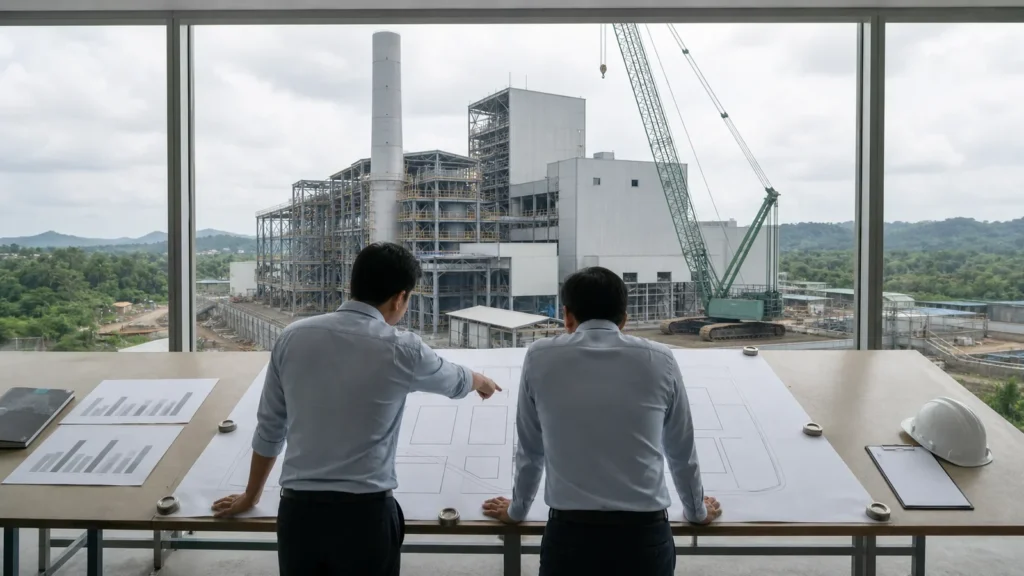
The 2026 record of waste-to-energy work across the region runs through five lines. Indonesia is building in Denpasar, Bali. Construction started there on 8 July 2026 for more than 500,000 tonnes of waste a year. Moreover, Malaysia launched Sungai Udang on 2 April 2026 at 1,056 tonnes a day and 22 MW. Thailand first synchronized On Nut on 10 April 2026 at 1,000 tonnes a day. Meanwhile, Singapore contracted a Tuas South upgrade on 19 March 2026 to burn 3,000 tonnes a day. Also, Viet Nam announced a Hung Yen plant on 6 March 2026 at 1,600 tonnes a day and 40 MW. I read waste to energy projects southeast asia by stage rather than by announcement. Municipal solid waste is the mixed rubbish a city collects, and waste-to-energy means burning it to make electricity.
How this piece is ordered
In this piece I work in a fixed order. I cover how I read a project list, Indonesia’s programme and the fastest-moving markets. In addition, I turn to what a developer has to bring, and what Malaysia put on paper. Specifically, I show how I test a name. Tonnes per day means the daily mass of mixed city rubbish a plant is built to take in.
In short
- Five 2026 lines: Denpasar, Sungai Udang, On Nut, Tuas South and Hung Yen, each with a date, a tonnage and a stage.
- Stage over announcement: I never add an announced capacity to an operating one.
- Indonesia: a nationwide rule signed on 10 October 2025 with USD 0.20/kWh fixed for a 30-year contract.
- Scale floor: an incineration plant generally needs at least 500 tonnes per day to make economic sense.
- Paper test: who guarantees the tonnage, what fixes the revenue, and who signs it.
In this article
How I read a project list
For example, the regional roundup of August 2026 gives me five lines. Indonesia: Denpasar, Bali, construction started on 8 July 2026 by Danantara Investment Management with the Weming Group, more than 500,000 tonnes of waste a year, IDR 3 trillion or about 184 million USD, completion expected in late 2027. Malaysia: Sungai Udang launched by Malakoff on 2 April 2026 at 1,056 tonnes of municipal solid waste a day and 22 MW gross. Thailand: On Nut first synchronized on 10 April 2026 at 1,000 tonnes a day, operational on 14 November 2026, 35 MW. Singapore: a Tuas South upgrade contracted by the National Environment Agency on 19 March 2026 to run to 2035, about SGD 890 million, 3,000 tonnes a day.
Viet Nam announced the Hung Yen plant on 6 March 2026. The site covers seven hectares, 1,600 tonnes a day and 40 MW. It serves a province of 3.5 million people making 3,000 tonnes of waste a day. Completion is due in the second quarter of 2027.
My rule: every line carries a date, a tonnage and a stage, and I never add them up.
What this means for you: three fields must sit on one line before I move on a name. They tell me whether I hold a project or a plan.
Who is building what in Indonesia
I keep this file in the circular industries section. The August 2026 legal briefing on Indonesia’s new regulation sets out Perpres 109/2025. Indonesia signed it on 10 October 2025 with nationwide eligibility at 1,000 tonnes of waste a day. BPI Danantara coordinates the scheme. The power purchase agreement fixes USD 0.20/kWh for 30 years. Meanwhile, PT PLN signs within 10 working days once the construction permits clear. The regulation also deems an environmental permit granted after two months of silence.
The programme targets about 33 locations, not operating plants. In addition, about IDR 50 trillion of Patriot Bond finances part of it. The first phase covers Bali, Bogor, Bekasi and Yogyakarta. Legok Nangka is the country’s first waste-to-energy public-private partnership. Its capacity reaches about 2,131 tonnes a day and 40.79 MW. Commercial close came before ground breaking in July 2026. That close put contracts, financing and permits all in place. Sponsors led by Sumitomo Corporation, Hitachi Zosen and PT Energia Prima Nusantara backed it. About 200 entities expressed interest and 85 qualified in the second selection wave.
What this means for you: I ask for the offtake document and the local waste commitment before I value an Indonesian site.
Where the fastest-moving markets are
The fastest movers are clear, and I set them against the plant guide I use to size a line. The Ramboll interview of January 2025 puts Malaysia and Thailand at the front of the region. By contrast, Thailand disposes of almost 50 percent of its total waste in landfill. It also offers subsidies and tax incentives for plants lower than 10 megawatts. These include an enhanced feed-in tariff, the price a utility pays for renewable electricity. Viet Nam concentrates on Hanoi, Ho Chi Minh City and the Mekong Delta.
The project needs both kinds of money. The public side has to hold a stable framework that long-term foreign investors will accept. By contrast, the private side has to build. Development banks are bringing more green financing. However, not every country has an Asian Development Bank ready to take debt or equity. Therefore, the two sectors have to work together.
Moreover, on the bench behind the work, Ramboll states 160 dedicated waste-to-energy project managers and engineers.
What this means for you: I read a fast market as a policy signal, and I still need a plant with a date on it.
What a developer actually has to bring
The Infrastructure Asia overview of waste management in Asia lists five tests: technology, waste quantity, the regulatory framework, commercial structuring and social perception. The rule of thumb is about 6 MJ/kg before combustion on a grate is worth considering, and municipal solid waste in the region often sits below it. An incineration plant generally needs at least 500 tonnes per day to make economic sense. Plants as small as 50 tonnes per day exist but are harder to finance.
Singapore shows the risk allocation. A 2001 tender for a fifth plant drew a single bid. Specifically, the National Environment Agency wanted the developer to carry finance, design, operational and demand risk. The 2005 re-tender adopted take-or-pay, where the buyer pays for the capacity whether or not it is used. Keppel Seghers was selected in 2005 and the plant started in 2009 at 800 tonnes a day and about 22 MW.
The Nambo project in West Java runs 1,500 tonnes a day on a 25-year build-own-operate-transfer concession. It sells refuse-derived fuel, waste pressed into a solid fuel, to a cement plant requiring at least 14 MJ/kg. That is the bar I apply in my technology maturity work.
What this means for you: I need the calorific number and the daily tonnage in writing before I trust a plant design.
What Malaysia has put on paper
The Xinhua report of April 2026 sets out Malaysia’s paper position. Malaysia plans 18 waste-to-energy plants nationwide by 2040, generating up to 600 megawatts. Moreover, they sit inside a national energy transition roadmap targeting 70 percent renewable capacity by 2050. Those two figures are a programme target, never installed capacity.
The plant with a date on it is Sungai Udang in Melaka. Groundbreaking took place on 2 April 2026, for 660 million ringgit, about 163 million US dollars. It should reach full operation by 2029, with up to 1,000 tons of solid waste a day and 22 megawatts. The tonnage behind any of these rows is a feedstock question. Also, the tonnage decides whether a plant has enough feed. I handle it in my feedstock supply work.
What this means for you: I keep the plan row and the built row apart, because only one of them earns revenue.
How I test a named developer before I call them a counterparty
Before I call a developer a counterparty I check the record behind the name. Indonesia generated about 56.63 million tonnes of waste in 2023. Also, only 39.01 percent of it was managed, which tells me where the feedstock actually sits. Two early plants are in commercial operation. Benowo in Surabaya at 11-12 MW and up to 1,600 tonnes a day, and Putri Cempo in Surakarta, both built under a 2018 decree that named twelve cities. An earlier Jakarta proposal ran into financing and affordability trouble.
For any new name I want a waste characterisation study covering at least one year. Wet and dry seasons must be included. Indonesian municipal solid waste is wetter and less segregated than in mature markets. As a result, calorific value, combustion efficiency and plant availability all move. The page I open first is the contracting and risk work behind a mandate.
What this means for you: a sponsor who can show that study has done the work a lender asks for first.
The five questions I ask before I trust a name
Five checks, in this order. First, which stage the line is in: announcement, selection, commercial close, construction or operation, and what date sits on that stage. Second, who guarantees the tonnage and under which contract, because a plant with no guaranteed delivery has no revenue. Third, what fixes the revenue and for how long. A tipping fee is the payment a municipality makes per tonne delivered. An electricity tariff does the same. I also check who may renegotiate either rate. Fourth, whether the capacity is installed or announced, and I never add the two together. Fifth, who sits on the sponsor list in a filed document rather than in a press release.
In fact, those five answers take an afternoon to collect and change how I price everything after them.
What this means for you: an answer that arrives as an intention goes into my file as an intention, with the date it was given.
How I would write the map in a credit paper
In a credit paper I write four dated rows and nothing more. Indonesia, 2023: about 56.63 million tonnes of waste generated, 39.01 percent managed. Indonesia, October 2025: USD 0.20/kWh fixed for a 30-year contract. Malaysia, April 2026: 18 plants and 600 megawatts by 2040, a target with a date on it. The region, August 2026: five project starts between 6 March and 10 April 2026, each with a tonnage and a stage.
Also, each row carries its month, its number and its status. Therefore, a reader can see in one pass what is operating and what is only planned. No total, no average, no capacity added to ambition. A credit paper is read by someone who goes looking for the weakest row first.
What this means for you: I would circulate those four rows before any deck, because they show how much of the pipeline is real.
Sources
- The Southeast Asia Desk, Waste-to-Energy Plants Surge Across Southeast Asia as Governments Tackle Waste and Energy Crises, 2026.
- HFW, Indonesia’s waste-to-energy sector: the next phase of investment and delivery, 2026.
- Ramboll, Garbage in, energy out: what you need to know when developing waste-to-energy projects in Southeast Asia, 2025.
- Infrastructure Asia, Trashing it Out: Waste Management in Asia, n.d.
- Xinhua, Malaysia to build 18 waste-to-energy plants under renewable energy push, 2026.
Frequently asked questions
Which countries in Southeast Asia have waste-to-energy projects under way?
Five appear in the 2026 record: Indonesia with construction in Denpasar started on 8 July 2026, Malaysia with Sungai Udang launched on 2 April 2026, Thailand with On Nut first synchronized on 10 April 2026, Singapore with a Tuas South upgrade contracted on 19 March 2026, and Viet Nam with a Hung Yen plant announced on 6 March 2026.
Who is developing the largest waste-to-energy plant in the region?
The largest daily tonnage described in these groups is Legok Nangka in West Java, about 2,131 tonnes of municipal solid waste a day and about 40.79 MW, built to take waste from six Greater Bandung municipalities. The Hung Yen plant is announced at 1,600 tonnes a day.
How much waste does a waste-to-energy project need every day?
The guides in these groups set the floor at 500 tonnes per day for an incineration plant to make economic sense, while a rule of thumb of about 6 MJ/kg governs grate combustion and municipal solid waste in the region often sits below it. Indonesia’s regulation requires a city to supply at least 1,000 tonnes of waste a day.
Is waste-to-energy capacity in Southeast Asia installed or announced?
Both exist and I keep them apart: a plant that runs, such as the 800 tonnes a day operating since 2009 in Singapore’s record, against a programme target such as 18 plants by 2040 in Malaysia, which is a plan with a date attached.
Not sure your project would survive a credit conversation?
A short call is usually enough to see where your project stands.
If you are mapping developers and partners before you commit a mandate, the work sits in my strategic partnerships service, where I turn a project list like this one into a shortlist of counterparties with dates, tonnages and stages attached.
I do not provide investment advice or arrange investments. I act as a strategic advisor and facilitator.

Alex, Founder of WeConnect Asia
I help low-carbon fuel and carbon removal project developers in Southeast Asia secure the commercial and financial partners needed to reach FID.
Related articles

Pitching a Climate Tech Company to Strategic Investors: What the Corporate Has to Believe Before It Writes a Cheque
How to pitch a climate tech company to strategic investors: the metric cluster, the readiness evidence and the ask that corporates fund.

Biomethane: What It Is, How It Is Made and Who Buys It
Biomethane is biogas cleaned to pipeline quality. I explain how it is made, how it differs from biogas and who buys it in Southeast Asia.

CO2 Sourcing for e-SAF Projects: What the Rules Allow and What the Contract Must Say
Biogenic CO2, direct air capture or industrial flue gas: which sources an e-SAF plant may use, what they cost and which contract terms make the fuel certifiable.

Operating Performance Guarantees for SAF Plants: What Lenders Ask For
Minimum guarantees, performance damages, retesting and who stands behind them: the operating guarantees a SAF plant needs to keep debt and offtake intact.

EPC and Construction Risk in SAF Plants: What a Lender Actually Tests
FEED scope, convertible EPC, performance guarantees and damages caps: the construction risk questions a SAF project must answer before financial close.

Matching Feedstock and Offtake Risk Back-to-Back in a SAF Project: How Lenders Read the Chain
Lenders do not buy a feedstock plan and an offtake plan separately. They buy the link between the two, and the link is where most SAF files break.