
Home » Technology and Performance Risk in Waste-to-Energy: What the Contract Has to Test
Technology and Performance Risk in Waste-to-Energy: What the Contract Has to Test
10 min read · Feb 13, 2026 · By Alex
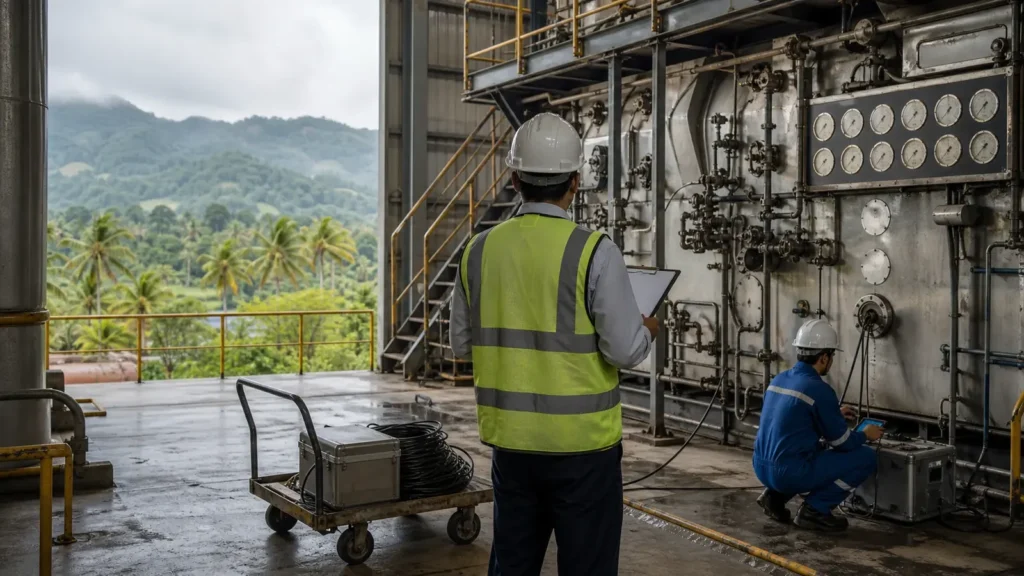
Performance risk in a waste-to-energy plant is the risk that the plant misses the availability. It also misses the output it promised. The loss then shows up as an availability deduction, a lower gate fee and lower electricity revenue. Availability is the share of contracted hours in which the plant can treat waste at the agreed output. An availability deduction removes payment whenever the plant misses that level. Throughput is the tonnage the plant can process in a given time. The waste is the first variable. Low calorific waste reduces electricity generation, while high calorific waste limits throughput. In addition, a set of 2013 thresholds requires at least 7 MJ/kg on average and never below 6 MJ/kg. I read waste to energy technology risk as a contract question first. I start from the waste-to-energy industry at pre-FID structuration.
What this article covers
Also, I take the question in order. First, where the risk sits in the contract. Then what the waste has to be. After that, what one 2025 rule demanded. Finally, what the published thresholds are. That leaves three things to cover. What to measure before signature, how performance turns up in the money, and how I would test your file.
In short
- Contract: The private partner carries the performance specification. In addition, a miss cuts the availability payment, the gate fee and the power revenue.
- Feedstock: Low calorific waste reduces electricity generation while high calorific waste limits throughput, so the waste is the first variable.
- Rule: A 2025 eligibility rule asks at least 1,000 tonnes a day for the whole operating period. The tariff is fixed for 30 years.
- Thresholds: The rules ask for at least 7 MJ/kg on average and never below 6 MJ/kg. They also ask for at least 100,000 tonnes a year before anyone considers incineration.
- Proof: One full year of seasonal waste characterisation, written acceptance criteria, and a test the authority can refuse to pass.
In this article
Where the performance risk sits
The Global Infrastructure Hub risk allocation matrix for waste to energy plants is explicit. The private partner carries the risk of meeting the performance specification. A miss on availability or on energy generation cuts revenue through availability deductions. It also cuts the gate fee revenue and the electricity revenue.
Suppose the authority must find alternative disposal. It then abates the availability payment. In a tonnage structure, the payment falls with the volume processed. Lower performance standards usually apply through the early operating period, to clear snagging and minor defects.
If the plant misses the specification during commissioning, the authority may refuse it, and operation never starts. Or it accepts a lower specification at a lower price. Untested technology carries a higher risk. Therefore, the private partner may ask for a wider margin between contractual commitments and expected performance.
What this means for you: I read the performance clause beside the waste clause. Low calorific waste reduces electricity generation, and high calorific waste limits throughput. In addition, energy sales are generally only 20 to 30 per cent of total project revenue.
Why the waste, not the boiler, decides performance
In the January 2025 Ramboll interview on developing waste-to-energy projects in Southeast Asia, the framing is literal. Garbage in, energy out. Waste composition guarantees run the whole project. Many governments assume it wrongly and end up with a badly operated plant.
A waste characterisation study measures what the waste actually contains. It has to cover all seasons for at least one year, wet and dry, using top-down and bottom-up sampling. Calorific value measures the heat that a kilogram of waste releases when it burns.
The public sector guarantees the waste stream, while the private partner carries the rest. Bankability starts in pre-feasibility with a proven technical solution, an optimal risk allocation and a clear payment mechanism. Southeast Asia grows electricity demand 4 percent a year to 2035, against 3 percent for energy demand overall. In addition, waste to energy sits inside it.
What this means for you: I do not sign a performance case on a boiler datasheet. Ramboll reports 160 project managers and technical staff dedicated to waste to energy. Its Maldives work diverts about 200,000 tonnes a year and produces 100,000 MWh.
What one 2025 eligibility rule demanded
In the August 2026 HFW note on Indonesia’s waste-to-energy sector, Indonesia signed Perpres 109/2025 on 10 October 2025. The rule sets four conditions. A project needs at least 1,000 tonnes of waste a day for the whole operating period. It also needs suitable land, funded collection and transport, and a local government commitment to that volume.
The authority deems environmental permits granted after two months from a complete file. In addition, the tariff runs at 0.20 USD/kWh for a 30-year power purchase agreement. That agreement must be signed within 10 working days once construction permits are met. Take-and-pay means the buyer pays for a committed quantity regardless of delivery. At publication, the acceptance criteria, fuel specifications and trial regimes still had no definition.
Indonesian municipal waste is wetter and less sorted than on mature markets. That moves calorific value, combustion yield and availability. The strategy is to adapt EPC and O&M risk allocation to those real feedstock and technology risks. It is not to import other markets’ profiles.
Two earlier commercial plants returned different results. Benowo runs at about 11 to 12 MW and up to 1,600 tonnes a day, and Putri Cempo is the second. Legok Nangka reached commercial close with about 2,131 tonnes a day and about 40.79 MW, before works began in July 2026. Indonesia produced about 56.63 million tonnes of waste in 2023, and managed 39.01 percent of it.
What this means for you: I do not underwrite a fixed tariff against an undefined acceptance regime. The price only pays if tonnage and fuel specification are fixed with it.
What the published thresholds are
More than 1,200 waste to energy installations operate in more than 40 countries. More than 1,000 of them burn municipal solid waste on a moving grate without pre-treatment.
The 2013 ISWA guidelines for waste to energy in low and middle income countries set the conditions. A mature waste system has a managed landfill already in place. It needs at least 100,000 tonnes a year of combustible waste. It needs a lower heating value, the heat available per kilogram once the water is accounted for, averaging at least 7 MJ/kg and never below 6 MJ/kg. In addition, it needs a community that will pay, qualified staff, and planning stable for more than 15 years.
Main fractions by calorific value: paper 16 MJ/kg, organic matter 4 MJ/kg, plastics 35 MJ/kg, textiles 19 MJ/kg, glass and metals 0. Combustion leaves about 10 percent of volume and about 20 percent of weight. Organic matter in bottom ash stays below 3 percent, against about 2 MWh of heat or 2/3 MWh of electricity per tonne.
In a weak system the key risks are variable tonnage, calorific value too low, insufficient financial support, unsuitable technology and an inadequate institutional framework. Informal waste pickers remove combustible fractions and change both composition and calorific value. So waste offtake contracts must name who carries it.
What this means for you: I test the file against these thresholds before I test the boiler. The plant is only as firm as the tonnage and heating value behind it.
What to measure before signing the file
In the Infrastructure Asia overview of waste management in Asia, the rule of thumb is about 6 MJ/kg before anyone considers moving-grate incineration. Southeast Asian municipal solid waste is often wetter. Therefore, developers add pre-treatment, storage hoppers to drain free water, or biological treatment.
Refuse-derived fuel is waste sorted, shredded and compressed into a fuel. Sent to cement kilns, it must reach at least 14 MJ/kg. Incineration generally needs at least 500 tonnes per day to make economic sense. Plants of 50 tonnes per day exist, at airports for example, but they are harder to finance.
Five considerations decide whether a plant can be built. They are appropriate technology, waste quantity, the regulatory framework, commercial structuring and social perception. On the last one, a plant of 2 x 1,000 tonnes a day with a ski-slope roof sits 200 metres from residences. It expects more than 300,000 visitors a year.
The developer must be sure of daily deliveries before it will carry the supply risk. My guide to building a plant sets out what must be measured before signature, including the commissioning and acceptance test. That test also covers the run in which the plant proves contracted output before acceptance.
What this means for you: I ask for the numbers in writing before the technology story. A plant built on an assumed composition is a plant that misses its availability.
How performance shows up in the money
In 2013 the published thresholds asked for at least 100,000 tonnes a year of combustible waste. They also asked for a lower heating value of at least 7 MJ/kg on average, with a floor of 6 MJ/kg.
Also, in 2025 a national rule tied a 30-year tariff of 0.20 USD/kWh to at least 1,000 tonnes a day for the whole operating period. The same rule made environmental permits deemed granted after two months from a complete file.
In 2023 Indonesia managed about 39.01 percent of about 56.63 million tonnes of waste. In July 2026 a project with about 2,131 tonnes a day and about 40.79 MW reached commercial close before works began.
If the authority takes the plant’s capacity, payment follows availability and falls when the plant misses availability or performance criteria. If payment follows tonnage, the same shortfall reduces the volume processed, and the payment follows it down. A gate fee and an electricity payment both move with performance. Therefore, the plant earns least when it can least afford to.
What this means for you: I put the technical review against these dated gates. A tariff fixed without renegotiation only pays if the plant delivers the tonnage it was built for.
The five checks I run on a performance case
Before I sign off, I run these five checks against the feasibility study and financial model, in this order:
- How the project measures calorific value, over how many seasons, and who pays when it misses. The January 2025 expectation is at least one year of seasons, wet and dry. A 25-year West Java structure of 1,500 tonnes a day specifies at least 14 MJ/kg.
- What the acceptance criteria and trial regime say, and whether take-and-pay language covers them. The October 2025 rule ties 0.20 USD per kWh for 30 years to at least 1,000 tonnes a day.
- Does the performance regime start lower in the early operating period, and how does the contract write the ramp back to the contracted level?
- Who runs continuity of service when the plant is down, and which payment the authority abates in the meantime.
- What margin the contract demands between commitments and expected performance, for a technology that has not run at this scale.
What this means for you: five written answers, each with a number and a date, are what I take to credit. Anything left as a discussion point stays out of the base case.
How I would test your plant
I would test your plant against four dated facts, in order:
- 2013: thresholds of at least 100,000 tonnes a year and at least 7 MJ/kg on average, before anyone considers incineration.
- 2016 to 2030: waste volumes rise from 802 million tonnes to 1.1 trillion tonnes. So the feedstock case must be tested against growth, not against one survey.
- 2025: the rule asks 1,000 tonnes a day for the whole operating period. The tariff runs for 30 years at 0.20 USD/kWh.
- July 2026: a commercial close reached with about 2,131 tonnes a day and about 40.79 MW before works began.
What this means for you: I want each of those four dates matched by a document in your file. A performance case built on undated assumptions gets read twice.
Sources
- Global Infrastructure Hub, Waste to Energy Plant, PPP Risk Allocation Tool, n.d.
- Ramboll, Garbage in, energy out: what you need to know when developing waste-to-energy projects in Southeast Asia, 2025.
- Herbert Smith Freehills, Indonesia’s waste-to-energy sector: the next phase of investment and delivery, 2026.
- International Solid Waste Association, Guidelines: Waste to Energy in Low and Middle Income Countries, 2013.
- Infrastructure Asia, Trashing it Out: Waste Management in Asia, n.d.
Frequently asked questions
What is an availability deduction in a waste-to-energy contract?
It is a reduction applied to the payment when the plant misses the contractual availability or performance criteria. Availability is the share of contracted hours in which the plant can treat waste at the agreed output, so the deduction removes payment for the hours it cannot. In a tonnage structure the same shortfall simply reduces the volume processed, and the payment follows it down.
Why does waste calorific value matter more than the boiler guarantee?
Because the boiler only converts what it is given. Low calorific waste reduces electricity generation while high calorific waste limits throughput, meaning the tonnage the plant can pass through. The accepted floor in the published guidelines is an average of at least 7 MJ/kg that never falls below 6 MJ/kg, and a boiler guarantee does not repair a waste stream that misses it.
What performance test should a lender require before financial close?
A waste characterisation study covering all seasons for at least one year, wet and dry, with top-down and bottom-up sampling, plus written acceptance criteria, trial regimes and a commissioning test that the authority can refuse to pass. If the plant does not meet the specification at that point, operation may never start, or a lower specification may be accepted at a lower price.
What size of plant makes performance risk worth underwriting?
The published rule of thumb is at least 500 tonnes per day for incineration to make economic sense, and at least 100,000 tonnes a year of combustible waste before incineration is considered at all. Plants of 50 tonnes per day exist, at airports for example, but they are harder to finance. Below those levels the performance risk sits on a thinner revenue base.
Not sure your project would survive a credit conversation?
A short call is usually enough to see where your project stands.
If you are at pre-FID and the performance case is not written yet, I can run the technology side with you. That covers technology maturity and scale-up support for the plant, the contract and the waste file. Bring the waste data and the draft performance clause, and I will tell you which one has to move.
I do not provide investment advice or arrange investments. I act as a strategic advisor and facilitator.

Alex, Founder of WeConnect Asia
In Southeast Asia, I help low-carbon fuel and carbon removal developers find the partners they need to reach FID.
Related articles

Pitching a Climate Tech Company to Strategic Investors: What the Corporate Has to Believe Before It Writes a Cheque
How to pitch a climate tech company to strategic investors: the metric cluster, the readiness evidence and the ask that corporates fund.

Biomethane: What It Is, How It Is Made and Who Buys It
Biomethane is biogas cleaned to pipeline quality. I explain how it is made, how it differs from biogas and who buys it in Southeast Asia.

CO2 Sourcing for e-SAF Projects: What the Rules Allow and What the Contract Must Say
Biogenic CO2, direct air capture or industrial flue gas: which sources an e-SAF plant may use, what they cost and which contract terms make the fuel certifiable.

Operating Performance Guarantees for SAF Plants: What Lenders Ask For
Minimum guarantees, performance damages, retesting and who stands behind them: the operating guarantees a SAF plant needs to keep debt and offtake intact.

EPC and Construction Risk in SAF Plants: What a Lender Actually Tests
FEED scope, convertible EPC, performance guarantees and damages caps: the construction risk questions a SAF project must answer before financial close.

Matching Feedstock and Offtake Risk Back-to-Back in a SAF Project: How Lenders Read the Chain
Lenders do not buy a feedstock plan and an offtake plan separately. They buy the link between the two, and the link is where most SAF files break.