
Home » Methanol Feedstock and Inputs: Four Things a Project Must Secure Before FID
Methanol Feedstock and Inputs: Four Things a Project Must Secure Before FID
10 min read · Nov 2, 2026 · By Alex
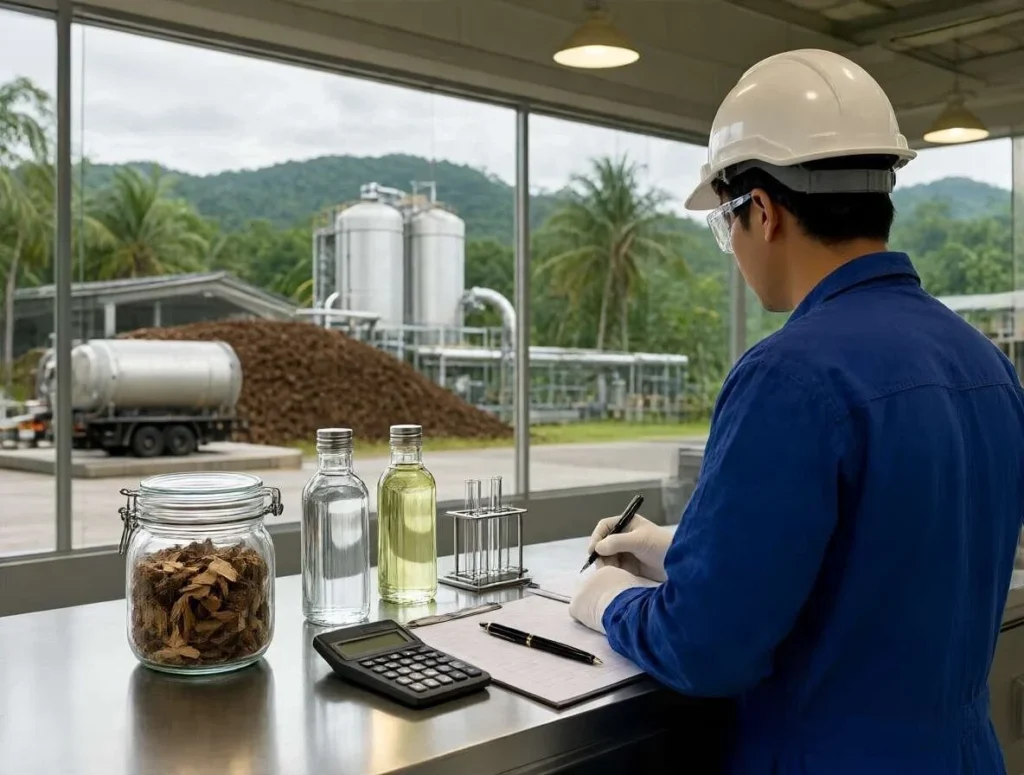
Four inputs decide whether I can sign a green methanol project. The first is a carbon feedstock at 0 to 17 USD per gigajoule for biomass and municipal solid waste. The second is green hydrogen. Specifically, electrolysis asks 9.5 to 10.5 MWh per tonne (IRENA and Methanol Institute, 2021; Maritime Propulsion, 2026). The third is carbon dioxide. Bioenergy with carbon capture and storage supplies it at 10 to 50 USD a tonne. Direct air capture costs 300 to 600 USD a tonne (IRENA and Methanol Institute, 2021). The fourth is a synthesis step. It runs at 250 to 280 degrees Celsius and 60 to 80 bar. Specifically, a copper-based catalyst carries it (IEA, January 2024). Those are the four methanol feedstock and inputs I would not sign without. The industry page carries the same picture.
What a pre-FID file must answer
A pre-FID file at structuration stage is never a reactor selection exercise. The questions I get are always the same four. I ask which input carries a contract, and at what price. I also ask for how long, and who absorbs the move if that price shifts.
In short
- Feedstock: Biomass and municipal solid waste run 0 to 17 USD per gigajoule (IRENA and Methanol Institute, 2021).
- Hydrogen: Electrolysis asks 9.5 to 10.5 MWh per tonne (Maritime Propulsion, 2026).
- Carbon dioxide: BECCS costs 10 to 50 USD a tonne (IRENA and Methanol Institute, 2021). Direct air capture costs 300 to 600 USD a tonne.
- Synthesis: 250 to 280 degrees Celsius and 60 to 80 bar over a copper-based catalyst (IEA, January 2024).
- Supply: the world produced 94 million metric tons in 2024. Renewable supply reached 400,000 to 500,000 tons (Methanol Institute, 2025).
In this article
Four inputs, one molecule
Before I look at a flowsheet I want to know what the plant eats. IRENA and the Methanol Institute recorded in 2021 that the world produces around 98 million tonnes of methanol each year. In fact, nearly all of it comes from fossil fuels, natural gas or coal. Meanwhile, renewable methanol accounts for less than 0.2 Mt a year. That gap is why my file has four contracts instead of one. A fossil plant takes a gas parcel or a coal parcel and a synthesis line. My project does not step into an existing green supply chain. By contrast, it buys four inputs a fossil methanol plant never had to buy separately. The four are solid carbon, electrons, a CO2 stream and a synthesis line. Moreover, each has its own published price range, counterparty and contract length.
What this means for you: I budget the file as four separate supply negotiations rather than one project. The molecule is identical either way, so all of the risk sits in those four contracts.
What green methanol actually is
Two routes, and the product is chemically identical to methanol from fossil sources (IRENA and Methanol Institute, 2021). Bio-methanol comes from biomass through gasification and reformation. Moreover, its feedstocks are forestry and agricultural waste and by-products, biogas, sewage and municipal solid waste. It also uses black liquor, the residue from cooking pulp and paper. E-methanol, also called power-to-liquid, comes from CO2 captured at renewable sources. In addition, it pairs that CO2 with green hydrogen produced with renewable electricity (IRENA, 2021). IRENA’s shipping pathway of 2021 labels routes by carbon intensity. Meanwhile, brown comes from coal, grey from natural gas. Green is the ideal production method. It splits into bio-methanol and e-methanol. The IEA recorded in January 2024 that methanol was first produced from synthesis gas in 1923. Syngas is the hydrogen and carbon monoxide mix you get from gasifying a feedstock. The definition page holds those labels.
What this means for you: the route choice is a feedstock and power choice, not a product choice. Buyers receive the same molecule, so I match the route to the input I can actually contract.
The carbon feedstock
Biomass and municipal solid waste feedstock costs vary between 0 and 17 USD per gigajoule (IRENA and Methanol Institute, 2021). In addition, waste streams from other industrial processes simplify feedstock logistics. Moreover, black liquor from paper mills, for instance, improves plant economics. The chemistry bites at gasification. IRENA recorded in 2021 that the optimal hydrogen to carbon monoxide ratio for methanol synthesis sits close to 2. As a result, biomass gasification produces a syngas with a low ratio, so I must adjust it. Nature Communications reported in September 2026 that gasification generates limited hydrogen. As a result, more than half of the biomass carbon ultimately ends up as CO2. IRENA put global methanol capacity at 98 Mt across more than 90 plants in 2021. The production page covers the route itself.
What this means for you: I size plant economics on the top of the published feedstock range. In fact, I ignore the midpoint. I also sign the waste stream agreement before I lock anything else in the file.
The hydrogen input
The IEA described the industrial process in January 2024. Specifically, synthesis gas reacts over a copper-based catalyst at 250 to 280 degrees Celsius and 60 to 80 bar. Moreover, modern catalysts allow more than 99.9% selectivity. The same report noted that e-methanol hydrogenates CO2 directly instead. Meanwhile, optimised versions already appear on the market. The raw methanol also contains water formed as a by-product of CO2 conversion. Therefore, I must remove most of that water. On the power side, Maritime Propulsion reported the power demand on 3 November 2026. As a result, electrolysis requires about 9.5 to 10.5 MWh per tonne.
The IEA also recorded that some components carry a low technology readiness level today. For example, reverse water-gas shift reactors need demonstration at scale. The reactor runs the water-gas shift reaction backwards. Specifically, it turns carbon monoxide and water into hydrogen and carbon dioxide. The hydrogen process is where that power cost is set.
What this means for you: I price the power contract before the synthesis loop. In fact, electricity is the only input I measure in MWh per tonne. Moreover, an electricity counterparty sells it.
The carbon dioxide input
IRENA recorded in 2021 that sourcing the renewable CO2 shapes sustainability. It also affects cost structure and production efficiency. In fact, the cost spread is the whole decision. IRENA and the Methanol Institute recorded this spread in 2021. CO2 from bioenergy with carbon capture and storage (BECCS) costs 10 to 50 USD a tonne. That CO2 puts e-methanol at 800 to 1600 USD a tonne. By contrast, direct air capture (DAC) CO2 costs 300 to 600 USD a tonne. That route puts e-methanol at 1200 to 2400 USD a tonne.
Nature Communications published the figures in September 2026. Gasification with renewable hydrogen reaches 92% carbon utilisation and 54% energy efficiency. Direct combustion followed by CO2 hydrogenation raises carbon utilisation to 96%. However, that route needs substantially more electrolysis-derived hydrogen. As a result, under hybrid wind and solar power, all four routes stay below the European low-carbon fuel threshold. Specifically, their emission factors run from 0.057 to 0.373 kilograms of CO2 equivalent per kilowatt-hour. The power-to-liquid route is the frame for those figures.
What this means for you: I fix the CO2 source before I quote a product price. In fact, the two published sources change the cost of a tonne by hundreds of dollars.
What the input bill does to finance
Bio-methanol costs an estimated 320 to 770 USD a tonne with feedstock up to 6 USD per gigajoule. As a result, process improvements drop that to 220 to 560 USD a tonne. E-methanol should fall to 250 to 630 USD a tonne by 2050. Meanwhile, renewable power prices keep dropping (IRENA and Methanol Institute, 2021). Nature Communications reported this ranking in September 2026. In fact, gasification without added hydrogen is the least-cost route today. Hydrogen-integrated gasification approaches that cost below 21 US dollars per megawatt-hour of renewable electricity. Consequently, it reaches coal-based methanol costs at carbon prices of 40 to 90 US dollars per tonne of CO2.
The Methanol Institute recorded that developers had announced more than 200 renewable and low-carbon projects by February 2025. As a result, that is a potential 45.8 million metric tons by 2030. Only 20 to 40% of them may move forward. The finance page reads the same bill from the debt side.
What this means for you: I take the least-cost route as the base case. Instead, I treat the announced 2030 pipeline as capacity I must test. I do not treat it as supply I can book.
What I would ask before signing a supply contract
I ask five questions in writing before any supply contract leaves my desk. Which of the four inputs carries a contract, and for how long. What does the feedstock price do at the top of its published range? The range runs from 0 to 17 USD per gigajoule (IRENA and Methanol Institute, 2021). And who absorbs the move? Where does the CO2 come from? BECCS costs 10 to 50 USD a tonne, while DAC costs 300 to 600 USD a tonne. It changes the product cost by hundreds of dollars a tonne (IRENA and Methanol Institute, 2021). At what power price is the electrolyser contracted? Electrolysis asks about 9.5 to 10.5 MWh per tonne (Maritime Propulsion, 3 November 2026). Which carbon intensity is the product certified against? The compatible emission factor runs from 0.057 to 0.373 kilograms of CO2 equivalent per kilowatt-hour (Nature Communications, September 2026).
What this means for you: I put those five answers in the term sheet itself. As a result, a change of feedstock supplier or CO2 source then becomes a renegotiation trigger. Instead, it is no longer a surprise.
How I would structure it if it were my own file
I keep four dated rows on the first page. The feedstock row carries the 0 to 17 USD per gigajoule range. It also carries the waste streams that improve plant economics (IRENA and Methanol Institute, 2021). The power row carries 9.5 to 10.5 MWh per tonne of electrolysis (Maritime Propulsion, 3 November 2026). The CO2 row carries BECCS at 10 to 50 USD a tonne. It sets DAC at 300 to 600 USD a tonne (IRENA and Methanol Institute, 2021). The output row carries bio-methanol at 320 to 770 USD a tonne. It carries e-methanol at 800 to 1600 USD a tonne (IRENA and Methanol Institute, 2021). Beside it sits the announced pipeline. The Methanol Institute recorded in February 2025 that developers had announced 45.8 million metric tons of potential capacity for 2030. Analysts expect only 20 to 40% to move forward. Every row carries its publisher and its date.
What this means for you: when the file reaches a lender, every input traces to a published figure. Each input also carries a date. Consequently, it moves to counterparty risk instead of where the numbers came from.
Sources
- IRENA and Methanol Institute, Innovation Outlook: Renewable Methanol, 2021.
- IEA, The Role of E-fuels in Decarbonising Transport, January 2024.
- IRENA, A pathway to decarbonise the shipping sector by 2050, 2021.
- Nature Communications, Toward efficient green methanol from biomass and renewable power, 4 September 2026.
- Methanol Institute, 2025 Milestones, 2025.
- Maritime Propulsion, Methanol-fuelled ships: a delivery story rather than an ordering story in 2026, 3 November 2026.
Frequently asked questions
What feedstocks can produce green methanol?
For bio-methanol: forestry and agricultural waste and by-products, biogas from landfill, sewage and municipal solid waste, and black liquor from the pulp and paper industry. For e-methanol: CO2 captured from renewable sources such as bioenergy with carbon capture and storage or direct air capture, together with green hydrogen produced with renewable electricity (IRENA and Methanol Institute, 2021; IRENA, 2021). IRENA’s shipping pathway of 2021 labels the resulting product by carbon intensity: brown from coal, grey from natural gas, green as the ideal production method.
What does e-methanol cost to produce?
Bio-methanol costs an estimated 320 to 770 USD a tonne with feedstock up to 6 USD per gigajoule, and 220 to 560 USD a tonne with process improvements. E-methanol is estimated at 800 to 1600 USD a tonne when the CO2 comes from bioenergy with carbon capture and storage at 10 to 50 USD a tonne, rising to 1200 to 2400 USD a tonne when it comes from direct air capture at 300 to 600 USD a tonne, and expected to fall to 250 to 630 USD a tonne by 2050 as renewable power prices drop (IRENA and Methanol Institute, 2021).
How much power does e-methanol need?
Electrolysis requires about 9.5 to 10.5 MWh per tonne (Maritime Propulsion, 3 November 2026). The IEA recorded in January 2024 that components with a low technology readiness level today, such as reverse water-gas shift reactors, still need to be demonstrated at scale.
Is there enough green methanol supply today?
No. The Methanol Institute recorded total methanol supply of 94 million metric tons in 2024 with just 400,000 to 500,000 tons of renewable product sold, and around 4 million metric tons of low-carbon, bio-methanol and e-methanol facilities operational or under construction as of February 2025. Announced capacity is not supply: the same institute recorded in February 2025 that more than 200 projects carrying a potential 45.8 million metric tons by 2030 had been announced, and that only 20 to 40% of them may move forward.
Not sure your project would survive a credit conversation?
A short call is usually enough to see where your project stands.
If you want those four rows built against your own contracts, my feedstock supply work starts from the published ranges above and from what you have already signed, then works back to the counterparty you still need. It is a structuration exercise, not a brokerage one.
I do not provide investment advice or arrange investments. I act as a strategic advisor and facilitator.

Alex, Founder of WeConnect Asia
I help low-carbon fuel and carbon removal project developers in Southeast Asia secure the commercial and financial partners needed to reach FID.
Related articles

Pitching a Climate Tech Company to Strategic Investors: What the Corporate Has to Believe Before It Writes a Cheque
How to pitch a climate tech company to strategic investors: the metric cluster, the readiness evidence and the ask that corporates fund.

Biomethane: What It Is, How It Is Made and Who Buys It
Biomethane is biogas cleaned to pipeline quality. I explain how it is made, how it differs from biogas and who buys it in Southeast Asia.

CO2 Sourcing for e-SAF Projects: What the Rules Allow and What the Contract Must Say
Biogenic CO2, direct air capture or industrial flue gas: which sources an e-SAF plant may use, what they cost and which contract terms make the fuel certifiable.

Operating Performance Guarantees for SAF Plants: What Lenders Ask For
Minimum guarantees, performance damages, retesting and who stands behind them: the operating guarantees a SAF plant needs to keep debt and offtake intact.

EPC and Construction Risk in SAF Plants: What a Lender Actually Tests
FEED scope, convertible EPC, performance guarantees and damages caps: the construction risk questions a SAF project must answer before financial close.

Matching Feedstock and Offtake Risk Back-to-Back in a SAF Project: How Lenders Read the Chain
Lenders do not buy a feedstock plan and an offtake plan separately. They buy the link between the two, and the link is where most SAF files break.