
Home » Municipal Waste Supply Agreements: The Clauses Lenders Read First
Municipal Waste Supply Agreements: The Clauses Lenders Read First
10 min read · Nov 26, 2025 · By Alex
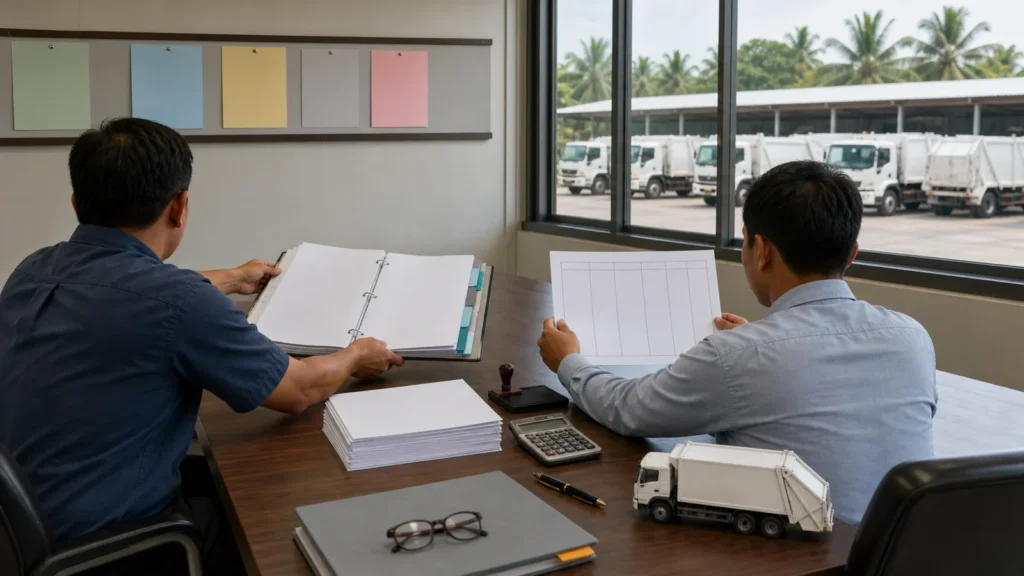
A lender reading a waste-to-energy plant’s waste delivery contract asks whether the tonnes will still arrive in year twelve. I give the same answer every time. A municipal waste supply agreement reassures a lender on three points. The municipality grants exclusive access to the waste for a term of not less than 25 years. It also warrants the minimum tonnage it must deliver. In addition, it pays the tipping fee, the per-tonne acceptance payment, on top of the power price. Without that warranty the plant carries a delivery risk it cannot hedge.
Here is the order I follow. I define the instrument, identify who stands behind the tonnage, and test what the stream must look like over the full term. I then work through a shortfall, read the payment side, and close on the drafting points I refuse to trade away.
In short
- Tipping fee: the payment made per tonne for accepting waste at the plant gate, also called a gate fee.
- Exclusivity: the right the municipality grants the plant to be the only taker of that municipal stream.
- Minimum tonnage: the annual quantity the municipality warrants, with a remedy when it is not delivered.
- Tenure: not less than 25 years as set in 2015, the period needed to recover the investment.
- Evidence: delivered tonnes, the paying budget line and its indexation, checked before I sign.
In this article
What a municipal waste supply agreement is
A municipal waste supply agreement commits a public authority to deliver a defined stream of municipal solid waste. The stream is the everyday waste households and businesses set out for collection. The authority must deliver it to a treatment plant for the life of that plant. The Asian Development Bank case story published in October 2015 sets out the concession model. The municipal government mandates a contractor who collects the waste and delivers it to the plant. It grants the concession, the long-term right to run the service. Moreover, it guarantees the waste supply and pays the tipping fee. Three clauses carry that structure. Exclusivity gives the plant sole access to that municipal solid waste for a term of not less than 25 years. That term is the time needed to recover the investment.
The minimum tonnage warranty makes the municipality answer for its failure to deliver the contracted quantity. The tipping fee pays for every tonne accepted at the gate.
What this means for you: I read those three clauses before I open the financial model, because the model holds only if exclusivity, the warranty and the fee hold.
Who stands behind the tonnage
The tonnage exists only if the collection system, the vans, crews and routes that carry waste from the household to the waste-to-energy plant, actually runs. The ISWA regional brief of July 2025 records how that system behaves in the field. In urban Indonesia, village-based collectors or the environmental agency carry out door-to-door collection. By contrast, rural collection is decentralised and oversight is inconsistent. In 2022, 47.64 percent of Indonesian waste reached sanitary or controlled landfills, 37.38 percent leaked into the environment. Also, only 48 percent of waste was treated. In Malaysia, local authorities hire contractors to run collection services under a law in force since September 2011. Also, 165 landfills operate there. Behind the tonnage warranty I look for a named contractor, a named budget line and a chain of custody that survives an election.
What this means for you: I ask who empties the bins when the plant runs short, and I price the gap between controlled disposal and the waste that never reaches a gate.
What the stream must look like for the full term
Continuous supply with a stable heat content is what keeps a plant inside its operating envelope. The ISWA guidelines of August 2013 set the condition. The plant must be an integrated part of the waste management system. Those guidelines require binding long-term agreements covering the tipping fees, the supply of waste and the sale of energy. Optimal operation relies on a continuous supply of waste, with small variations in lower calorific value. That value is the heat released per kilogram when the waste burns. I start from my circular waste-to-energy industry page, then I read the stream itself.
Two forces move that figure inside the contract term. First, scavengers lift recyclable and combustible fractions before the truck reaches the gate. That changes composition and heat content. Meanwhile, seasonal changes and religious traditions shift moisture and food waste, and with them the delivered calorific value. I therefore ask for a specification, a sampling regime and a rejection right, all dated in the contract.
What this means for you: I put a calorific value range and a sampling regime into the contract, because a stream that drifts is a stream a lender will discount.
What happens when delivery falls short
When delivery falls short I read the aggregate first. Also, the World Bank’s What a Waste 3.0 report of March 2026 records it plainly: 2.56 billion tonnes of waste produced in 2022, rising to 3.86 billion tonnes by 2050, with collection rates as low as 31 percent in Sub-Saharan Africa and 67 percent in South Asia where most waste is openly dumped. The global cost of municipal waste management already runs above US$250 billion a year and is projected to reach US$426 billion by 2050. The same 2026 report puts the sector at about 18 million urban waste workers and estimates that closing the gap needs US$556 billion of investment between 2022 and 2050. Those are the conditions under which a municipal delivery quietly fails. This is why infrastructure project finance treats the delivery warranty as a first-order term.
What this means for you: I treat the warranty as the only hedge against a collection system that, in 2026 data, runs as low as 31 percent, and I price it as a credit term rather than a covenant.
The payment side of the contract
Payment risk sits in procurement history. Also, the 2014 Carbon Trust and IESR study of Indonesia records a Surabaya tender whose process lasted about 4 years, was judged lacking in transparency and was influenced by political forces that demanded lower tipping fees even after the award, against a 20 year contract term. The same 2014 findings show local authorities there appearing prepared to pay roughly USD 9-10 per tonne. Meanwhile, the industry stated a need for about USD 25-30 per tonne for incineration, and show that the two revenue lines together had to deliver an internal rate of return of about 15 percent. A fee reopened after award is a fee I cannot model. This is why I read the offtake agreements next to the supply side.
What this means for you: I fix the fee, its indexation and every review date before the tender closes, and I treat any reopening after award as a reason to reprice the whole debt case.
Drafting points I do not negotiate
Four points are non-negotiable in the markup I produce with my contracting and risk management work. The revenue split: the 2015 concession model took about one third of revenue from tipping fees and two thirds from the Feed-in Tariff, a fixed price the grid pays for electricity, so supply and power are underwritten together. The guarantee: in 2015 a full and irrevocable sponsor guarantee backed a 100 million USD A loan and a 100 million USD B loan. The procurement remedy: in 2014 municipal buying was to be fixed with standardised contract templates and benchmark cost information. The floor: from 2013 the annual intake must be at least 100,000 tonnes of combustible waste at an average lower calorific value of at least 7 MJ/kg.
I also add a delivery obligation under which the municipality hands over the contracted tonnes or pays for the shortfall, which is what makes the supply side bankable, ready for a lender to underwrite.
What this means for you: I will not sign a supply side missing the guarantee, the template or the tonnage floor, because those are the three points a credit committee tests first.
What I would test before I sign
Five checks go on one page before I sign. One: the delivered tonnage of the last full year against the contracted minimum, with the shortfall written beside it. Two: who pays the tipping fee, from which budget line and with which indexation, since a fee indexed to nothing is a fee that erodes. Three: the exclusivity clause and the waste source it covers, noting that the 2015 model gave the contractor exclusive access plus a municipal guarantee of supply. Four: the shortfall remedy, whether it is a replacement tonnage, a fee abatement or a termination right. Five: the term against plant life and the waste hierarchy, since a right that outlives the policy direction of the stream is a mismatch I have to price.
What this means for you: I write those five checks on a single page before the credit paper is drafted, and any line I cannot evidence becomes a condition precedent rather than a covenant I hope someone monitors.
How I would write the supply side in a credit paper
I present the supply side as four dated rows so the reader can check each claim without a narrative.
- Structure, 2015: exclusive concession, a term of not less than 25 years, and a minimum tonnage warranty backed by the municipality.
- Delivery, 2025: door-to-door collection in urban Indonesia, with 47.64 percent of waste reaching controlled disposal there in 2022.
- System, March 2026: collection rates as low as 31 percent in Sub-Saharan Africa and 67 percent in South Asia, where most waste is openly dumped.
- Price, 2014: USD 9-10 per tonne asked against USD 25-30 per tonne needed for incineration.
Each row carries its own date. Also, each date carries its own caveat: an announced target is not an installed capacity. Also, a tendered price is not a paid price. The rows also show where my evidence is thin. Also, that is where I ask for a condition precedent instead of a promise.
What this means for you: I write those four rows first, then the debt schedule, because the reader who accepts the supply side will usually accept the rest.
Sources
- ISWA, Regional Brief: Waste Management Challenges & Opportunities in South East Asia, 2025.
- ISWA, Guidelines: Waste to Energy in Low and Middle Income Countries, 2013.
- World Bank, What a Waste 3.0, 2026.
- Carbon Trust and Institute for Essential Services Reform, Waste to energy in Indonesia, 2014.
- Asian Development Bank, The People’s Republic of China’s Municipal Waste-to-Energy Project, 2015.
Frequently asked questions
What does a municipal waste supply agreement cover?
It covers three things: exclusive access to the waste stream, the minimum amount the municipality must deliver, and the tipping fee paid per tonne. Those three sit alongside the electricity sale under a long-term contract, so plant revenue does not rest on the power price alone. Exclusive access means no other taker is admitted to that municipal stream for the term, which is what protects throughput when cheaper disposal alternatives compete for the same trucks.
How long should a waste supply contract run?
Long enough for the operator to recover the investment. The concession in the 2015 case story ran for a term of not less than 25 years, and a tender run in 2012 set a 20 year contract. A shorter term leaves part of the capital unrecovered when the rights end. The term is the second thing I check after the tonnage warranty, because a contract that expires before the equipment does hands the delivery risk straight back to the sponsor.
What happens if the municipality delivers less waste than promised?
How a waste supply agreement handles shortfalls
The warranty in the agreement is what covers the operator against that failure. Without it the plant carries a delivery risk it cannot pass to the power purchaser, whose own volume warranties run the other way. The remedy I ask for is that the municipality either delivers replacement tonnes or pays for the shortfall it created. A replacement tonnage keeps the plant whole, a fee abatement only halves the problem, and a termination right is the last resort; I price all three before signing.
Who pays for the waste delivered to a waste-to-energy plant?
The municipal government pays the tipping fee for each tonne it delivers. Households and businesses fund collection through local budgets and, in one Southeast Asian market, pay a waste fee of 0.5 to 2 USD a month in 2025. Two lines therefore meet at the plant gate: the public payment for taking the waste, and the private payment for the power that waste becomes, each settled on its own date and by its own payer.
Not sure your project would survive a credit conversation?
A short call is usually enough to see where your project stands.
If you are assembling the supply side for a plant before financial close, I will review the draft, mark the clauses that will not survive credit committee and hand you a redline list with every fact dated. The starting point is my feedstock supply work.
I do not provide investment advice or arrange investments. I act as a strategic advisor and facilitator.

Alex, Founder of WeConnect Asia
I help low-carbon fuel and carbon removal project developers in Southeast Asia secure the commercial and financial partners needed to reach FID.
Related articles

Pitching a Climate Tech Company to Strategic Investors: What the Corporate Has to Believe Before It Writes a Cheque
How to pitch a climate tech company to strategic investors: the metric cluster, the readiness evidence and the ask that corporates fund.

Biomethane: What It Is, How It Is Made and Who Buys It
Biomethane is biogas cleaned to pipeline quality. I explain how it is made, how it differs from biogas and who buys it in Southeast Asia.

CO2 Sourcing for e-SAF Projects: What the Rules Allow and What the Contract Must Say
Biogenic CO2, direct air capture or industrial flue gas: which sources an e-SAF plant may use, what they cost and which contract terms make the fuel certifiable.

Operating Performance Guarantees for SAF Plants: What Lenders Ask For
Minimum guarantees, performance damages, retesting and who stands behind them: the operating guarantees a SAF plant needs to keep debt and offtake intact.

EPC and Construction Risk in SAF Plants: What a Lender Actually Tests
FEED scope, convertible EPC, performance guarantees and damages caps: the construction risk questions a SAF project must answer before financial close.

Matching Feedstock and Offtake Risk Back-to-Back in a SAF Project: How Lenders Read the Chain
Lenders do not buy a feedstock plan and an offtake plan separately. They buy the link between the two, and the link is where most SAF files break.