
Home » Public-Private Partnerships for Waste-to-Energy: What the Contract Actually Carries
Public-Private Partnerships for Waste-to-Energy: What the Contract Actually Carries
10 min read · Feb 9, 2026 · By Alex
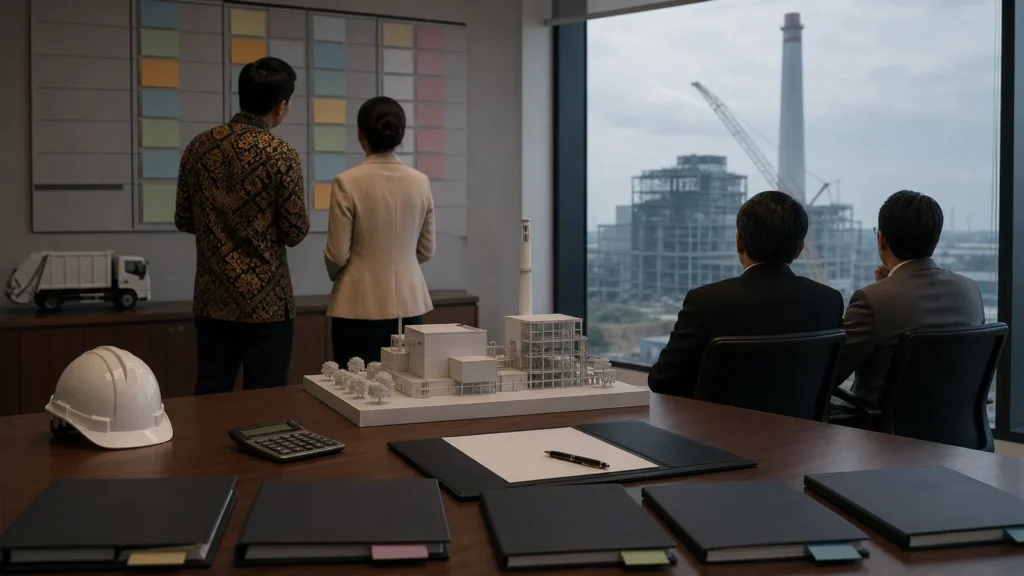
A waste-to-energy industry contract answers one question first: who carries the waste risk. A public-private partnership, or PPP, is a long-term contract under which a private company finances, builds, operates and hands back a plant against payments from a public authority; what it changes is that the authority usually keeps the waste supply risk and the payment mechanism. A waste to energy ppp signed in Belgrade in 2017 was backed by 259.57 million euros of financing and guarantees. In Southeast Asia the sector runs on public-private partnership and build-operate-transfer models, where the partner builds, operates and hands the plant back, and where the tipping fee, the gate fee paid per tonne accepted, the feed-in tariff and refuse-derived fuel prices are the critical success factors.
I lay this out in order: what the contract is, what the private side takes on, what a signed Southeast Asian deal looks like, what a financed package looks like, how a lender reads the term sheet, where the public side still carries the risk, then how I check one. Every figure sits beside its date.
In short
- Contract: Financing, construction, operation and handback move to a private company; the authority keeps waste supply and the payment covenant.
- Supply: Gate fee and power revenue follow tonnage, so a developer rarely accepts an uncertain waste stream.
- Payment: The authority either pays for keeping the plant available or pays per tonne against a tonnage it guarantees.
- Package: Senior loans from several lenders sit beside guarantees covering part of the equity and of the political risk.
- Checks: Volume guarantee, payment mechanism, construction period inside the term, bonds required at tender, authority covenant strength.
In this article
What a waste-to-energy PPP signs away, and what it does not
A public-private partnership does not move everything: financing, construction and operation move to the private company, while the authority keeps the waste supply and the payment covenant. The Infrastructure Asia overview of waste management in Asia describes a sector running mainly on public-private partnership and build-operate-transfer models, and five considerations decide whether a plant is buildable: technology, waste quantity, regulatory framework, commercial structuring and social perception.
The tipping fee, the feed-in tariff for power and the price of refuse-derived fuel are the critical success factors, and developers will probably not carry an uncertain waste stream given the capital at stake. Incineration needs at least 500 tonnes per day to make economic sense; regional waste is projected to move from 802 million tonnes in 2016 to 1.1 trillion tonnes in 2030; a 1,500 tonnes a day plant in West Java runs under a 25-year build-own-operate-transfer concession, the grant of an exclusive right to receive and treat waste for a term long enough to recover the investment, for a cement buyer requiring at least 14 MJ/kg; Philippine local governments can group to sign long-term contracts and joint ventures.
What this means for you: I settle the waste quantity, the tariff and the site before I compare contract shapes, because no structure carries an unresolved one of the three.
What the private side actually takes on
The January 2025 Ramboll interview on developing waste-to-energy projects in Southeast Asia reports that design, build, own, operate and transfer schemes are the most common and that the public sector picks the model according to the risk it wants to keep. Split European style packages of engineering, supply, construction and maintenance are harder to finance in Southeast Asia, because investors prefer one entity to assuming the risk. The waste-to-energy case must be bankable from early pre-feasibility: a proven technical solution, an optimal risk allocation and a clear payment mechanism built on tipping fees and feed-in tariffs.
Supply is literal: it is garbage in, energy out. The public sector must guarantee the waste stream while the private side carries the rest, and a waste characterisation study must cover all seasons for at least one year. Electricity demand in Southeast Asia is projected to grow 4 percent a year to 2035 against 3 percent for energy demand overall.
In 2025, Ramboll reports 160 project managers dedicated to waste-to-energy, and in Asia Pacific it delivered a plant in the Maldives that diverts about 200,000 tonnes from landfill a year and produces 100,000 MWh.
What this means for you: I ask who guarantees the waste stream before I model the tariff, because the payment mechanism only sits on top of a guaranteed tonnage.
What a signed Southeast Asian PPP looks like
The August 2026 HFW note on Indonesia’s waste-to-energy sector describes Legok Nangka, the first waste-to-energy PPP in Indonesia: commercial close on about 2,131 tonnes a day from six municipalities of Greater Bandung and about 40.79 MW, with a sponsor group led by Sumitomo Corporation, Hitachi Zosen and PT Energia Prima Nusantara, before works began in July 2026. For the sizing behind that deal I use the waste-to-energy plant guide.
Perpres 109/2025, signed on 10 October 2025, fixes a simplified tariff of 0.20 USD/kWh for a 30-year power purchase agreement that PT PLN must sign within 10 working days once construction permits are met. Eligibility under the 2025 rules needs at least 1,000 tonnes a day, suitable land and funded collection and transport, and environmental permits are deemed granted after two months of a complete file. Coordination sits with BPI Danantara, about 33 sites are discussed, financing is expected partly through about 50,000 billion roupies of Patriot Bonds, and about 200 entities have expressed interest while 85 were qualified in the second wave of the selected supplier list.
Under Perpres 35/2018, two commercial plants, Benowo at about 11-12 MW and up to 1,600 tonnes a day, and Putri Cempo, produced different results. Indonesia generated about 56.63 million tonnes of waste in 2023, of which 39.01 percent was managed.
What this means for you: I read the eligibility floor and the tariff together, because a site below 1,000 tonnes a day in 2025 rules itself out of the programme whatever the technology offers.
What a financed PPP package looks like
The 2019 MIGA press release on the Belgrade waste-to-energy PPP describes a package of 259.57 million euros of financing and guarantees provided to the project company for a partnership that closes and remediates a saturated landfill, builds an EU-compliant sanitary landfill, a waste-to-energy facility and a construction and demolition waste plant, with construction expected to take up to three and a half years. Under that stack sit the long-term offtake and waste contracts, an offtake being the contract in which a buyer commits to take the power or the heat.
Also in 2019, the International Finance Corporation portion was an A loan of up to 72.2 million euros, a parallel loan of up to 35 million euros from Oesterreichische Entwicklungsbank, a B loan of up to 35 million euros and a concessional senior loan of up to 20 million euros, beside an EBRD loan of up to 128.2 million euros. The contract was awarded in 2017 to a company formed by Suez S.A., Itochu Corporation and Marguerite Fund II, with the International Finance Corporation structuring the project for the city from 2014.
In 2019, MIGA guarantees of 97.3 million euros run for up to 20 years against non-commercial risks including breach of contract and cover up to 90 percent of investor equity. On the same 2019 figures, the project is expected to produce electricity for about 30,000 households and cover 80 percent of the city’s winter heat need.
What this means for you: I check that the guarantees sit against the same obligations the lenders rely on, because a stack that covers the loan but not the sponsor’s equity still leaves the equity exposed.
How I read a PPP term sheet
I start with the payment mechanism, because it decides who eats a bad year. The Global Infrastructure Hub risk allocation matrix for waste to energy plants gives two routes: where the authority takes the entire capacity, revenue is an availability payment, money paid for keeping the plant available, with deductions or penalties when availability and performance standards are missed; where third-party waste fills spare capacity, payments are per tonne backed by a guaranteed minimum quantity, a tonnage the authority commits to deliver or pay for, and the private partner then carries part of the demand risk.
Energy sales typically account for 20 to 30 per cent of overall project income, charged per kWh, with the offtaker generally committing to take all output. The partner usually signs a lump-sum construction contract to pass obligations down, and accepts the risk that subcontractor liability caps are reached or that subcontractor warranties end before its own defect obligations. Performance security runs from bid bonds at tender to completion bonds and performance bonds, and its cost feeds into pricing. Delay means lost revenue, higher interim disposal costs and continuing construction and financing costs, with termination for missing the longstop date, the outside date after which the contract can end, in the extreme case. Where the authority’s credit is weak, a sovereign or central government guarantee may be needed, so I check the support available from development finance institutions.
What this means for you: I read the payment clause, the security schedule and the termination clauses in that order, because each one reprices the deal before any lender looks at it.
Where the public side still carries the risk
The public side carries whatever it refuses to price. In 2001 a tender for a new plant drew a single bid because the authority left financing, design, operation and demand risk with the developer. The 2005 re-tender adopted take-or-pay, under which the government buys 100 percent of the incineration capacity or pays a penalty; that contract was awarded in 2005 and the plant started in 2009 at 800 tonnes a day and about 22 MW.
In that market the authority pays an availability-based payment while the private partner faces deductions for missed standards. A contract awarded in 2017 in Belgrade was backed by guarantees covering up to 90 percent of investor equity, and an October 2025 tariff decision fixed 0.20 USD/kWh for 30 years. Reading the project finance picture for Southeast Asia beside these dates shows the same pattern: the demand risk sits wherever the payment sits.
What this means for you: if the public side will not hold the demand risk in some form, I expect the tender to come back undersubscribed, because that is what happened in 2001.
The five checks I run on a PPP before I call it financeable
In order: which side guarantees the waste volume, and what compensation applies when it is not delivered; which payment mechanism is used, availability or per tonne with a guaranteed minimum quantity; how long the construction period sits inside the term, and what happens at the longstop date; what performance security is demanded, and who pays for it; whether the authority’s payment covenant is strong enough to avoid a sovereign guarantee.
Anchors I hold against those answers: construction of up to three and a half years in 2019, take-or-pay over 100 percent of capacity from 2005, a tariff of 0.20 USD per kWh for 30 years fixed in October 2025, and an eligibility floor of 1,000 tonnes a day from 2025.
What this means for you: a file that answers all five in writing is a file I take to a lender, and one that answers three is a file I keep working on.
How I would read your PPP file
Four dated rows sit on the first page. 2001: one bid, demand risk left with the developer. 2005: take-or-pay over 100 percent of capacity, with the plant running from 2009. 2017: a contract awarded with guarantees over 90 percent of equity. 2025: a 30-year tariff fixed on 10 October 2025.
I put your draft beside them and ask which row it behaves like, then I mark the gap between what the contract promises and what the payment mechanism actually pays.
What this means for you: send the draft contract and the payment schedule, and I will tell you which of those four rows your structure resembles and where it breaks.
Sources
- Infrastructure Asia, Trashing it Out: Waste Management in Asia, n.d.
- Ramboll, Garbage in, energy out: what you need to know when developing waste-to-energy projects in Southeast Asia, 2025.
- Herbert Smith Freehills, Indonesia’s waste-to-energy sector: the next phase of investment and delivery, 2026.
- MIGA, IFC and MIGA Support Pioneering Waste-to-Energy PPP Project in Belgrade, 2019.
- Global Infrastructure Hub, Waste to Energy Plant, PPP Risk Allocation Tool, n.d.
Frequently asked questions
What is the difference between a PPP and a concession for a waste-to-energy plant?
A public-private partnership is the wider long-term contract under which a private company finances, builds, operates and hands back the plant. A concession is the grant of the exclusive right to receive and treat the waste for a term long enough to recover the investment. One West Java structure ran as a build-own-operate-transfer concession of 25 years over 1,500 tonnes a day.
Which risks should the public authority keep in a waste-to-energy PPP?
Typically the waste supply and the payment covenant. The authority either pays an availability-based payment or guarantees a minimum quantity of waste, and it must organise alternative disposal when the plant is shut down.
How long does a waste-to-energy PPP take to reach financial close?
The record in these materials runs from a contract awarded in 2017 to construction expected to take up to three and a half years, with financing assembled from several lenders and guarantees. The honest answer for any single file is that it depends on permits, on the tariff decision and on how long the guarantees take to put in place.
What happens if the authority does not deliver the guaranteed waste volume?
The compensation logic in the contract applies: the private partner is usually made no better and no worse than if the waste had been delivered, covering the lost gate fee and the lost generation, and it may be required to look for substitute waste first.
Not sure your project would survive a credit conversation?
A short call is usually enough to see where your project stands.
If you are structuring a waste to energy ppp before FID and want a second read on the allocation before it is fixed, talk to me about a strategic partnership.
I do not provide investment advice or arrange investments. I act as a strategic advisor and facilitator.

Alex, Founder of WeConnect Asia
I help low-carbon fuel and carbon removal project developers in Southeast Asia secure the commercial and financial partners needed to reach FID.
Related articles

Pitching a Climate Tech Company to Strategic Investors: What the Corporate Has to Believe Before It Writes a Cheque
How to pitch a climate tech company to strategic investors: the metric cluster, the readiness evidence and the ask that corporates fund.

Biomethane: What It Is, How It Is Made and Who Buys It
Biomethane is biogas cleaned to pipeline quality. I explain how it is made, how it differs from biogas and who buys it in Southeast Asia.

CO2 Sourcing for e-SAF Projects: What the Rules Allow and What the Contract Must Say
Biogenic CO2, direct air capture or industrial flue gas: which sources an e-SAF plant may use, what they cost and which contract terms make the fuel certifiable.

Operating Performance Guarantees for SAF Plants: What Lenders Ask For
Minimum guarantees, performance damages, retesting and who stands behind them: the operating guarantees a SAF plant needs to keep debt and offtake intact.

EPC and Construction Risk in SAF Plants: What a Lender Actually Tests
FEED scope, convertible EPC, performance guarantees and damages caps: the construction risk questions a SAF project must answer before financial close.

Matching Feedstock and Offtake Risk Back-to-Back in a SAF Project: How Lenders Read the Chain
Lenders do not buy a feedstock plan and an offtake plan separately. They buy the link between the two, and the link is where most SAF files break.