
Home » Biogas Grants and DFI Funding: What Public Money Pays For
Biogas Grants and DFI Funding: What Public Money Pays For
10 min read · Jan 12, 2026 · By Alex
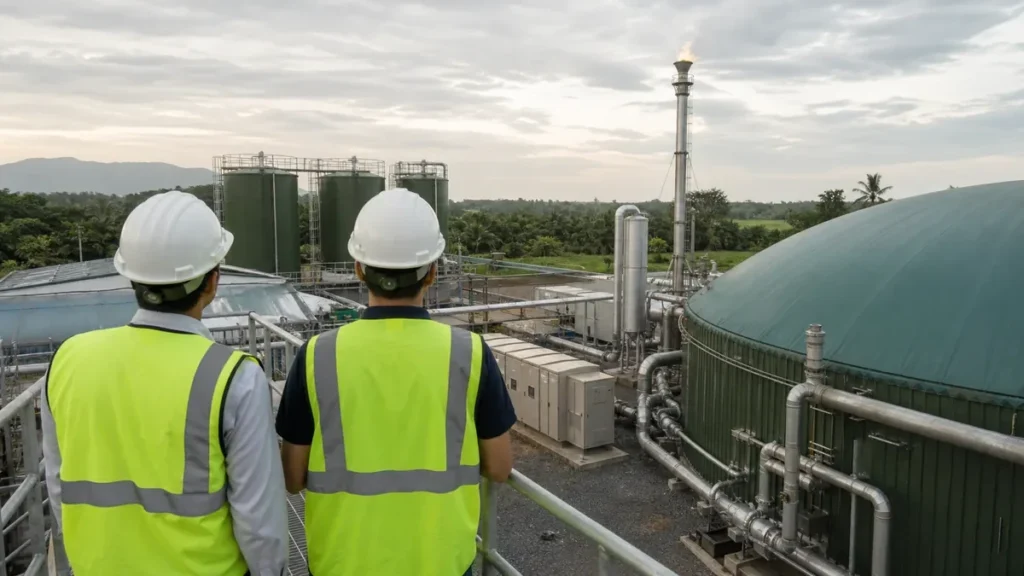
Public money in a biogas project pays for four things and never for the plant alone. It closes the gap between contracted revenue and cost. Also, it carries the risk no commercial lender will take, it pays for the studies that come before any buyer signs. In addition, it holds a policy floor under the price. In most reporting countries production still depended on investment support or subsidies to be financially viable in 2024. Therefore, the useful question is not how much money exists but which risk a given instrument is contractually willing to carry. I line up biogas grants, public credit and guarantees against those four uses inside the biogas, biomethane and biofuels branch.
Where biogas (methane-rich gas produced by anaerobic digestion, the breakdown of organic matter without oxygen) and biomethane (the same gas after upgrading, the removal of carbon dioxide and other contaminants) are financed on policy rather than on merchant price. An offtake agreement (the contract under which a buyer takes the output) is what the early studies are waiting for.
The order below follows that logic. First the four uses, then the instruments that carry them. After that come the support schemes, the policy menu and the demand side. Finally the questions I ask, and the order I run them in. Each instrument sets the calendar. That calendar decides when the project reaches FID, the final investment decision at which the owners commit the capital.
How the four uses fit together
In short
- Four uses: revenue gap, lender risk, early studies, price floor.
- Guarantee: a public facility of 65 million USD was approved for compressed biogas in July 2025.
- Collateral: lenders were asking for guarantees of up to 120 percent of loan value in 2021.
- Support: in most reporting countries production needed investment support or subsidies in 2024.
- Menu: the 2023 policy study lists grants, low interest loans and loan guarantees among its best practices.
In this article
What public money is for in a biogas project
Take the four uses one at a time. The revenue gap is the part of the cost that contracted output does not cover. In addition, a grant (money that does not have to be repaid) closes it without adding a repayment. The lender risk is the share of loss a bank refuses to hold. A guarantee covers exactly that: a third party promises to take part of the loss. The studies are the feasibility, environmental and grid work a buyer wants before it signs anything, spent while there is no contract to pledge. Also, the policy floor is a feed-in tariff, a price the law fixes and a buyer pays for each unit delivered. That tariff makes revenue legible to a lender and therefore bankable, able to support debt against contracted revenue.
Each of those four uses carries an obligation. That covers reporting, procurement rules, a cap, an end date or a condition on the feedstock. Support still carried viability for most reporting countries in 2024. However, no public money arrives free of a condition, and none arrives early by default.
What this means for you: put the four uses on one page and mark which risk each candidate instrument takes. An instrument that closes the revenue gap does nothing for the lender risk. In addition, a guarantee does nothing for the studies.
The instruments that exist, and what each one carries
A development finance institution is a public or semi-public lender owned by states. It lends where the commercial book is thin and attaches conditions a bank cannot. The clearest published case is the ADB and Green Climate Fund announcement of July 2025. Also, the fund approved 200 million USD at its board meeting of 1 July 2025 for a programme led by the bank to mobilise public and private investment in clean energy.
The concessional funding supports a blended finance facility that will extend lines of credit to qualified national development finance institutions. In addition, those national institutions hold the project pipeline. The same programme finances round the clock renewables, green hydrogen, compressed biogas, rural electric transport and decentralised renewable energy. In that July 2025 structure the central mechanism is a risk sharing facility of 65 million USD. It provides partial credit guarantees, so smaller developers can reach affordable finance. That covers compressed biogas projects commercial lenders overlook because of the risks they carry.
The structure matters more than the headline. In that July 2025 programme a partial guarantee of 65 million USD sits inside 200 million USD of approved funding. It reaches projects only through national lenders that screen the pipeline and report on it.
What this means for you: ask who screens the pipeline and who reports. When a DFI offers a line, those two answers date your timetable more tightly than the amount does.
What a guarantee changes for a lender
Project finance work starts where the collateral stops. The Global Innovation Lab guarantee fund description published in 2021 puts the constraint in figures. Lenders were demanding real estate or cash guarantees of up to 120 percent of the loan value in 2021, which prices independent developers out of the market. That is the first test I run in my project finance work, because a guarantee is only worth what a lender agrees to accept as one.
In that 2021 design the vehicle is the first environmental guarantee fund of its country. A closed fixed income fund that invests only in treasury bills and pledges its own shares as collateral. In the same 2021 design the initial loan portfolio is 67 million USD. It rises to as much as 258 million USD over 10 years. In addition, it would enable 43 projects and mitigate up to 331 000 tonnes of CO2 equivalent per year. That effect runs over its first 10 years.
Also in 2021, individual guarantees are capped at 10 percent of each project and range from 530 000 USD to 6 million USD, the fund can raise up to three times its resources once it has a track record, and national biogas capacity in that market stood at 300 MW, below 0.1 percent of the energy mix.
What this means for you: ask what share of your loan the facility covers. In addition, what ceiling applies per project, then check that the residual collateral demand is one your balance sheet can actually meet.
What a support scheme has to survive
A support scheme is only as good as the schedule written into it. The 2024 reporting shows why. In most reporting countries production has depended on investment support or subsidies to stay financially viable. That is the finding of the IEA Bioenergy Task 37 country report of September 2024. In 2024 data the United Kingdom pays an indexed tariff over 15 years. The rate is 5.51 p/kWh on the first 60 GWh injected and 3.53 p/kWh on the next 40 GWh. Beyond that it falls to 1.56 p/kWh.
In the same 2024 reporting Switzerland usually finances a plant over a 20 year repayment period and compensates 50 percent of the costs directly linked to energy production. Also, in 2024 China operated more than 100 000 plants and Germany more than 10 000. That is what a settled framework produces over decades. In addition, that is why I read the Malaysian biogas feed-in tariff as a legal text before I read it as a price. A grant is worth less than a tariff written into law that survives a revision.
What this means for you: check the end date and the indexation rule before you size anything against a tariff. Treat support announced rather than legislated as no revenue at all.
The policy menu behind the money
Before the model exists there is a menu, and the menu tells me which door to knock on. The IRENA agricultural residue study came out in 2023. It lists grants, low interest loans and loan guarantees for bioenergy projects among its financial best practices. Alongside those it puts sales tax exemptions, carbon taxes, targeted financing through banks and public private partnerships. On the technical side it lists a one window permitting process, rules that restrict landfilling of organics, and feedstock grading. The same 2023 study puts the global technical potential of agricultural by-products at between 30 EJ and 60 EJ per year, which is the volume the financing chain has to move.
The menu is also a filter. A grading rule decides which residue streams qualify, and a landfill restriction changes what a gate fee is worth. That fee is what an owner pays a facility to accept its material. Both change the revenue before any lender is asked to accept a number, and that is the layer infrastructure project finance prices first.
What this means for you: list the doors the menu opens. File the permit and grading work each one requires. A complete model with an incomplete permit file will not open any of them.
Where the demand side stands for this region
The demand side decides whether any of this scales. Also, the IEA biogas and biomethane outlook published in 2020 puts close to 600 Mtoe of sustainable biogas production in reach, with developing economies holding two thirds of the global potential and around 30 percent in developing Asia. In that 2020 outlook about 100 Mtoe of the current potential costs no more than natural gas. That is three and a half times current world production.
In addition, that same 2020 outlook names four barriers for developing economies. They are absent dedicated policies, high capital cost, limited information and a skills shortage. Revenues from digestate are modest. Digestate is the material left after digestion and used as a fertiliser. Captured carbon dioxide adds little, and neither one closes the gap with natural gas. Competitiveness therefore rests on pricing the externalities. That means a carbon price on natural gas combustion and a value on avoided methane emissions. It is the same calculation behind the biomethane market in Southeast Asia.
What this means for you: ask whether your revenue case survives without a carbon price. The 2020 analysis puts the closing of the gap on the price of externalities, not on the plant.
The five questions I ask before promising support money
Five questions, in the order I ask them, decide whether I will tell a developer that support money is realistic.
- 1. Is it law or an announcement? Most reporting countries still relied on investment support or subsidies in 2024. Therefore, a headline without a legal basis is not revenue.
- 2. Does it carry a guarantee? Lenders asked for up to 120 percent of loan value in 2021. Therefore, the real question is who covers the part the bank will not.
- 3. What does it require in procurement and reporting? Lines of credit through development finance institutions come with pipeline and disclosure conditions in 2025.
- 4. When does the tariff end? The United Kingdom schedule runs 15 years on 2024 data. In addition, a shorter end date changes what can be sized against it.
- 5. Does the model survive a late grant? Capital cost and information gaps were still the barriers identified in 2020, and both bite hardest when cash is delayed.
What this means for you: run the five questions in order and stop at the first no. A second yes cannot repair a first no.
How I would sequence the application work
I run four steps, in this order:
- Map the risk each instrument carries against the risk the project actually has. Drop any instrument built for a risk you do not have.
- File the study and permit work that every instrument asks for, since all of them ask for the same file.
- Open the development finance conversation before the equity term sheet, because both take longer than the financial close.
- Keep the guarantee conversation separate from the grant conversation, so that one delay does not stop the other.
Support money is a calendar as much as a cheque, and that calendar produces the FID date.
What this means for you: build the application calendar first. Attach each instrument to the risk it carries. Let the FID date fall out of the sequence, not out of a hoped for cheque.
Sources
- Asian Development Bank, ADB and GCF Partner to Launch Clean Energy Financing Program in India, 3 July 2025.
- Global Innovation Lab for Climate Finance, Guarantee Fund for Biogas Projects, 2021.
- IEA Bioenergy Task 37, A perspective on the state of the biogas industry in 12 member countries, September 2024.
- IRENA, Agricultural residue-based bioenergy: Regional potential and scale-up strategies, 2023.
- IEA, Outlook for biogas and biomethane: Prospects for organic growth, 2020.
Frequently asked questions
What do grants pay for in a biogas project?
They pay for the early work that has no revenue behind it yet: studies, permits and the gap that remains after the contracted revenue is counted. In most reporting countries, production still depended on investment support or subsidies to be financially viable in 2024.
What is a guarantee facility?
It is a pool that pledges collateral on behalf of developers so a lender can extend a loan it would otherwise refuse. In one published 2021 design, individual guarantees are capped at 10 percent of each project and range from 530 000 USD to 6 million USD, against lender collateral requirements of up to 120 percent of loan value.
Can a biogas project be financed without a subsidy?
Only where the contracted revenue covers the full cost. The 2020 outlook put world production costs between USD 2/MBtu and USD 20/MBtu with Southeast Asia around USD 9/MBtu, and it identifies absent dedicated policies and high capital cost as the barriers that support money is meant to remove.
Which instrument should come first, grant or debt?
The grant or guarantee conversation, because both carry conditions that change the debt case: development finance lines of credit come with pipeline and reporting obligations in 2025, while tariff support that runs for 15 years on 2024 data is what a debt tenor is sized against.
1
A short call is usually enough to see where your project stands.
If you want the sequence above run against your own project, start with my grants and incentives work and bring the four uses page with you.
I do not provide investment advice or arrange investments. I act as a strategic advisor and facilitator.

Alex, Founder of WeConnect Asia
I help low-carbon fuel and carbon removal project developers in Southeast Asia secure the commercial and financial partners needed to reach FID.
Related articles

Pitching a Climate Tech Company to Strategic Investors: What the Corporate Has to Believe Before It Writes a Cheque
How to pitch a climate tech company to strategic investors: the metric cluster, the readiness evidence and the ask that corporates fund.

Biomethane: What It Is, How It Is Made and Who Buys It
Biomethane is biogas cleaned to pipeline quality. I explain how it is made, how it differs from biogas and who buys it in Southeast Asia.

CO2 Sourcing for e-SAF Projects: What the Rules Allow and What the Contract Must Say
Biogenic CO2, direct air capture or industrial flue gas: which sources an e-SAF plant may use, what they cost and which contract terms make the fuel certifiable.

Operating Performance Guarantees for SAF Plants: What Lenders Ask For
Minimum guarantees, performance damages, retesting and who stands behind them: the operating guarantees a SAF plant needs to keep debt and offtake intact.

EPC and Construction Risk in SAF Plants: What a Lender Actually Tests
FEED scope, convertible EPC, performance guarantees and damages caps: the construction risk questions a SAF project must answer before financial close.

Matching Feedstock and Offtake Risk Back-to-Back in a SAF Project: How Lenders Read the Chain
Lenders do not buy a feedstock plan and an offtake plan separately. They buy the link between the two, and the link is where most SAF files break.