
Home » Green Ammonia Buyers: Fertiliser, Power and Shipping
Green Ammonia Buyers: Fertiliser, Power and Shipping
10 min read · Feb 2, 2026 · By Alex
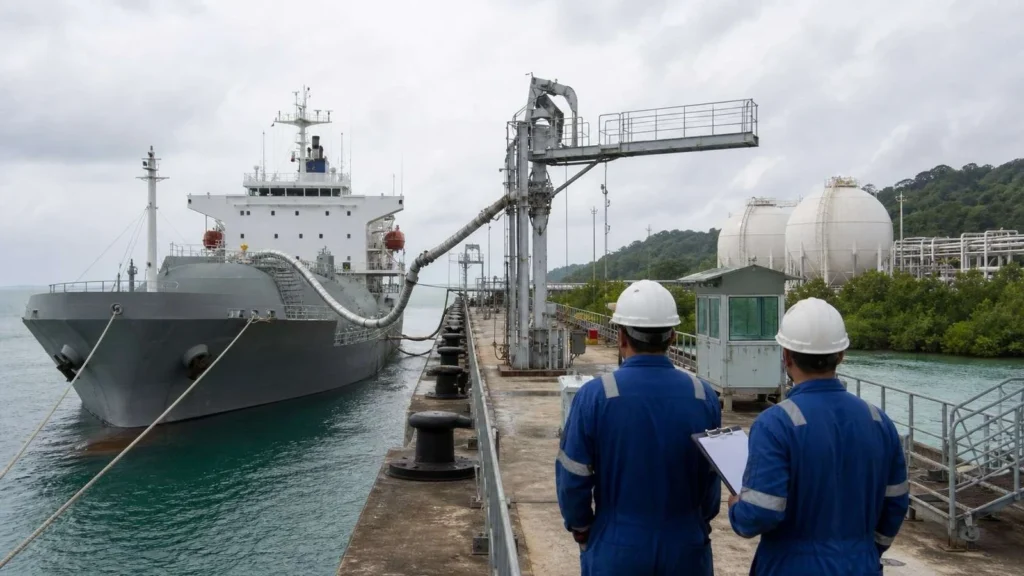
Three doors are open to a green ammonia producer and they do not pay the same way. Fertiliser buyers take 77 percent of the 187 million tonnes of ammonia consumed each year as of 2021. Fertiliser here means the nitrogen products such as urea that growers spread on fields. Power generators in Japan, South Korea and Singapore are also building co-firing capacity, which means burning ammonia alongside coal. Meanwhile, shipping has ordered vessels for a fuel it does not yet buy at volume. Which of the green ammonia buyers you approach first decides the contract you can sign. Therefore, I set the order out through the green ammonia guide and then rank each door by what it can actually commit. I write for a concept-stage developer who must pick one segment and call it.
How I rank green ammonia buyers, door by door
I order four buyer types in the order I would approach them. First the buyer you already have, then the buyer who pays for scope 3, the buyer who signs for power, and last the buyer still building ships. Each gets a section, and each closes with the move I would make next.
In short
- Fertiliser first: 77 percent of the 187 million tonnes consumed each year as of 2021 goes to fertilisers, and that buyer already owns a contract template.
- Scope 3 second: consumer goods companies with 850 billion USD of food and beverage revenue in 2025 fund the switch for 1 to 3 percent at finished product level.
- Power third: Japan, South Korea and Singapore buy pilot and co-firing volume, not baseload volume.
- Shipping last: an order book of 178 million tonnes a year that appears only in a 2050 scenario.
- Count signed, not announced: in January 2024, 45 of 185 tracked projects had offtake agreements.
In this article
Who buys ammonia at all
I define an ammonia buyer as any party willing to bind itself to take a tonne of ammonia. The terms have to be agreed in writing. Ammonia is an industrial chemical traded as a liquid. Also, most of it is turned into urea, a granular nitrogen fertiliser, or nitrates before it reaches a field. Co-firing is burning ammonia alongside coal. Marine fuel is the shipping use, where a vessel burns ammonia instead of fuel oil. A hydrogen carrier is ammonia moved to another place to release hydrogen there. An offtaker is the party legally bound to buy. The ladder approach sells into small near-term pockets first. Take-or-pay makes the buyer pay for contracted volume whether or not it lifts it. The Tampa benchmark is the monthly reference price for traded ammonia. A guarantee of origin is a document stating how a particular tonne was produced.
What this means for you: I write down which of these words my target buyer already uses. A buyer who quotes Tampa and asks for take-or-pay is a trading desk, not a brand.
The buyer you already have
The existing market is where I start. The BloombergNEF and Climate Technology Coalition white paper of January 2024 puts ammonia demand at 187 million tonnes in 2021. Fertilisers take 77 percent and industrial uses such as explosives and plastics the other 23 percent, and ammonia goes into 54 percent of all fertilisers. Production and use account for 2 percent of the world’s carbon dioxide emissions in 2021. The market, worth 76 billion USD in 2021, consumes 33 million tonnes of hydrogen a year out of 94 million tonnes of global hydrogen demand. It runs on capacity of 243 million tonnes a year, with China close to a third. In 2021, five companies took up to 70 percent of traded volume out of about 820 firms. Meanwhile, the five largest producers held only about 15 percent of capacity.
Before any buyer call, I read how green ammonia is actually produced.
What this means for you: this buyer already owns a contract template, a price index and a logistics chain. My job is to fit a green tonne into that process rather than to sell it a new one.
The buyer who pays for scope 3
The second door is the buyer who pays for scope 3. This means meane the emissions a company does not create itself but that sit in its supply chain. The Hydrogen Council and McKinsey & Company roadmap of November 2025 finds that nearly half of the 20 largest fast-moving consumer goods companies have set scope 3 targets. Those companies carry 850 billion USD of annual food and beverage revenue in 2025, and more than half of all food grown relies on ammonia fertilisers made in more than 60 countries. In 2025, switching to low-emission ammonia raises end product cost by 1 to 3 percent. It cuts product emissions by up to 30 percent, against organic premiums of 20 to 40 percent. Pooling those buyers reduces counterparty risk, creates bankable offtake volumes and moves a producer from FEED to final investment decision.
Certification systems and book-and-claim let the claim survive a global supply chain. Book-and-claim means the environmental attribute travels on paper while the physical tonne follows the market. Also in 2025, 40 to 50 percent of the world’s population depends directly on manufactured nitrogen fertiliser, at about 20 kg per person. Before I carry a claim anywhere, I check what a plant has to prove.
What this means for you: I approach the pooled consumer buyer with a certification route and the finished product cost line, not with a tonne and a promise. That cost line is what gets a signature.
The buyer who signs for power
Japan and South Korea promote ammonia co-firing with coal for baseload generation. The case is contested on cost grounds. However, it creates a real procurement channel, and in 2024 I treated it as one. Singapore’s national strategy allows hydrogen up to 50 percent of projected electricity demand in 2050. As of 2024, Keppel Infrastructure is building a 600 MW hydrogen-ready combined-cycle plant and examining a 60 MW ammonia-fuelled one. Meanwhile, Envision Energy is building a 1.52 million tonne green ammonia plant in China. The ladder approach places mining explosives and gas power generation in the near-term pocket, before fertilisers and shipping. In 2024 a proposed consumer coalition would also signal purchase interest early. My route into this door runs through the Southeast Asian and Singapore market.
What this means for you: this buyer purchases demonstration volume before baseload volume. Therefore, I size the first offer to a plant trial rather than to a fleet, and I expect the specification to be written with the utility’s engineers.
The buyer who is still building ships
One net zero scenario puts ammonia consumption by the shipping sector at 178 million tonnes a year in 2050. In 2024 dozens of maritime freight companies were piloting low-carbon fuel or ordering vessels able to run on ammonia. I call that an order book rather than a market: it arrives through newbuild decisions and bunker infrastructure, not through today’s cargo contracts. Ammonia also has to pass a safety test before that buyer scales. It is a hazardous substance, deadly accidents have happened, and wider use in new sectors will pose safety and security challenges as of 2024. A modelled trade view in 2025 puts roughly 310 Mtpa of ammonia supply in 2040 flows. This is a projection and not an order. The hydrogen behind the tonne decides whether the buyer’s claim holds. Therefore, I read what makes hydrogen green before I price anything.
What this means for you: I would not spend a year chasing a shipping counterparty at concept stage. A vessel order is a signal and a cargo contract is a commitment, and only the second one pays for a plant.
What I will not count as a buyer
The International Energy Agency Global Hydrogen Review 2026 shows low-carbon production up 20 percent in 2025 to almost 1 Mt, expected to pass 1 percent of global production in 2026. About 80 percent of high-availability production aims at chemicals, refining and low-carbon fuels, and the announced pipeline reaches 27 Mt to 2030. I hold four further exclusions. An announcement is not an order: in January 2024, 45 of 185 tracked projects had offtake agreements. A final investment decision is not a delivery: 1.3 Mtpa was online in May 2025 out of 15 Mtpa at final investment decision. An expression of interest is not a contract, since 90 percent of traded ammonia still moves on one to three year contracts in 2024.
Spare capacity is not demand either, with utilisation around 80 percent on 243 million tonnes of capacity in 2024. A retrofit, meaning new equipment inside an existing grey plant, is the only announced tonnage I treat as close to real.
What this means for you: I ask four questions of any approaching party. Where is the signed order, where is the delivered tonne, where is the firm contract, and where is the money already spent?
What this means for a Southeast Asian developer
The International Energy Agency Southeast Asia briefing of 9 December 2025 puts regional demand at 4 Mt in 2024. Ammonia takes 49 percent of that demand, against refining at 31 percent and methanol at 20 percent. The country split runs Indonesia at 35 percent, Malaysia at 22 percent, Viet Nam at 15 percent and Singapore at 12 percent. Only Indonesia and Malaysia export, Malaysia taking 73 percent of regional exports and the region 17 percent of world ammonia exports in 2023. Announced regional projects equal 12 percent of current demand. Meanwhile, only 6 percent of announced capacity has reached final investment decision. 11 Mtpa of potential sits below 6 USD/kg by 2030. No certification scheme is yet in place, with work under way in three countries, and 6.6 billion USD of development finance institution loans flowed between 2021 and 2025.
What this means for you: the regional buyer map is fertiliser first, power pilots second, shipping last. Also, the barriers named in 2026 are high costs, uncertain demand, slow or complex regulation and insufficient infrastructure. I read how development finance institutions lend before I choose which of those barriers to attack first.
The four lines I would put in front of a buyer
Line one, demand signal: the World Bank Energy Sector Management Assistance Program survey of February 2026 puts ammonia at about 42 percent of electrolyser projects worldwide under construction, the largest project segment. Line two, deliverability: installed electrolyser capacity was about 2.15 GW mid-2025, or 0.2 percent of global hydrogen demand, with 16 GW under construction and 3.5 GW at final investment decision, and manufacturing capacity of 61 GW a year as of February 2026. Third line, price: the best projects today sit at about 3 USD per kilogram. Also, most sit above it, as of February 2026. Line four, credibility of supply: less established technologies carry higher financing costs unless warranties or guarantees step in, and financing requirements can push a project towards established contractors and proven equipment, also as of February 2026.
What this means for you: I lead with the demand signal, prove deliverability and price second, and treat credibility of supply as the question that decides whether the buyer’s legal team signs at all.
Sources
- BloombergNEF and Climate Technology Coalition, Scaling Up Hydrogen: The Case for Low-Carbon Ammonia https://assets.bbhub.io/professional/sites/24/CTC-whitepaper_Ammonia_Final.pdf, January 2024.
- Hydrogen Council with McKinsey & Company, Fertilizing the future: A roadmap to scale low-emission ammonia fertilizers https://hydrogencouncil.com/wp-content/uploads/2025/11/Fertilizing-the-future-FINAL.pdf, November 2025.
- IEA, Global Hydrogen Review 2025, Southeast Asia, 9 December 2025 https://iea.blob.core.windows.net/assets/745a259b-9cb7-4e1d-9ba1-a8b63d1eaae8/GHR2025_SEA_Webinar.pdf, 2025.
- IEA, Global Hydrogen Review 2026, Executive summary https://www.iea.org/reports/global-hydrogen-review-2026/executive-summary, 2026.
- World Bank, ESMAP, Electrolyzers for Hydrogen Production: Technical and Economic Characteristics https://documents1.worldbank.org/curated/en/099022326123011297/pdf/P506220-b45b0865-8706-4862-8792-d8cc71f84569.pdf, February 2026.
Frequently asked questions
Who is the largest buyer of ammonia today?
Fertilisers, which took 77 percent of the 187 million tonnes of ammonia demand in 2021, with industrial uses such as explosives and plastics taking the remaining 23 percent and 54 percent of all fertilisers made with ammonia. By 2024 that demand sat on capacity of 243 million tonnes a year running at utilisation around 80 percent.
Should a green ammonia developer approach fertiliser buyers or shipping first?
Fertilisers first. They are the existing market, and the switch costs 1 to 3 percent at the finished product level while cutting product emissions by up to 30 percent. Shipping is still an order book, with 178 million tonnes a year of consumption appearing only in a 2050 net zero scenario. Pooling consumer buyers also lets the claim travel through certification rather than through the physical tonne.
What do power utilities in Asia actually buy?
Pilot and co-firing volumes. Japan and South Korea promote ammonia co-firing with coal, Singapore allows hydrogen up to 50 percent of projected electricity demand in 2050, and one operator there is building a 600 MW hydrogen-ready plant while examining a 60 MW ammonia-fuelled one as of 2024.
What stops an announced buyer from signing?
Three things. A price that can be two to three times grey ammonia against a benchmark tied to natural gas, contracts in the traded market that stop at one to three years, and a claim that needs certification before a buyer can book it. In January 2024, 45 of 185 tracked projects had offtake agreements at all.
Not sure your project would survive a credit conversation?
A short call is usually enough to see where your project stands.
If you want this buyer map turned into a term sheet, my offtake agreement structuring work covers volume, duration, price index and certification in one pass, and I start by ranking your doors in the order above.
I do not provide investment advice or arrange investments. In addition, I act as a strategic advisor and facilitator.

Alex, Founder of WeConnect Asia
I help low-carbon fuel and carbon removal project developers in Southeast Asia secure the commercial and financial partners needed to reach FID.
Related articles

Pitching a Climate Tech Company to Strategic Investors: What the Corporate Has to Believe Before It Writes a Cheque
How to pitch a climate tech company to strategic investors: the metric cluster, the readiness evidence and the ask that corporates fund.

Biomethane: What It Is, How It Is Made and Who Buys It
Biomethane is biogas cleaned to pipeline quality. I explain how it is made, how it differs from biogas and who buys it in Southeast Asia.

CO2 Sourcing for e-SAF Projects: What the Rules Allow and What the Contract Must Say
Biogenic CO2, direct air capture or industrial flue gas: which sources an e-SAF plant may use, what they cost and which contract terms make the fuel certifiable.

Operating Performance Guarantees for SAF Plants: What Lenders Ask For
Minimum guarantees, performance damages, retesting and who stands behind them: the operating guarantees a SAF plant needs to keep debt and offtake intact.

EPC and Construction Risk in SAF Plants: What a Lender Actually Tests
FEED scope, convertible EPC, performance guarantees and damages caps: the construction risk questions a SAF project must answer before financial close.

Matching Feedstock and Offtake Risk Back-to-Back in a SAF Project: How Lenders Read the Chain
Lenders do not buy a feedstock plan and an offtake plan separately. They buy the link between the two, and the link is where most SAF files break.