
Home » Exporting Hydrogen to Japan and South Korea: What I Verify Before I Sign an Export Term Sheet
Exporting Hydrogen to Japan and South Korea: What I Verify Before I Sign an Export Term Sheet
10 min read · Sep 15, 2025 · By Alex
An export deal into Tokyo or Seoul is settled before price enters the room. Also, I run three checks first: the carrier I convert into. This means meane the molecule I put on a ship, and what that conversion costs me in energy, the volumes. Also, costs the buyer has published about itself, and whether the buyer’s certification scheme recognises the way I measure emissions. I write for a developer or an offtaker. This is a buyer committing to take delivery of a set volume on set terms under an offtake agreement. An offtake agreement is a contract to purchase a defined quantity over a defined period. It structures a green hydrogen sale before the final investment decision. That decision is the point at which the board releases the capital.
A hydrogen export japan korea deal is a chain design question before it is a price question. Get the chain wrong and no headline price repairs it.
The short answer before the detail
Below I order the argument in three moves: what physically crosses the water. Also, what that step costs me, what each of the two buyers has actually put in writing. Also, then what I refuse to count as demand. Announced volumes, unsigned agreements and scenario values stay out of my demand column.
In short
- Carrier: the molecule I convert into decides my energy bill and which terminals I can use, and I price the trip back to hydrogen separately.
- Buyer targets: Japan and South Korea publish volume and cost targets, and I treat each one as a target rather than a delivered volume.
- Certification: I confirm the buyer’s scheme accepts my emissions boundary before I put a number on anything.
- Firmness: only about 20% of newly signed volumes in 2025 were firm.
- Delivery: the delivery point and the last leg decide who absorbs the conversion penalty.
In this article
The question I am actually answering
The real question is not what my hydrogen costs at the fence. The question is whether a molecule I make in Southeast Asia can become something shippable. The cargo must cross the water and pass the buyer’s certification scheme. A terminal in Tokyo or Seoul then pays for it. That answer is decided by chain design rather than by price. Price is the output of a chain, not an input I choose.
So I run three checks before any commercial conversation. The carrier I convert into and the energy that conversion eats, which sets my landed cost floor. The volume and cost targets the buyer has published about itself, which tell me what its institutions are held to. Whether the buyer’s certification scheme accepts the way I measure emissions, because an unrecognised measurement is not a saleable attribute.
What this means for you: if any check fails, the chain does not exist. I then price a term sheet against it. Also, I would rather resolve that before the commercial conversation than discount it later.
What physically crosses the water
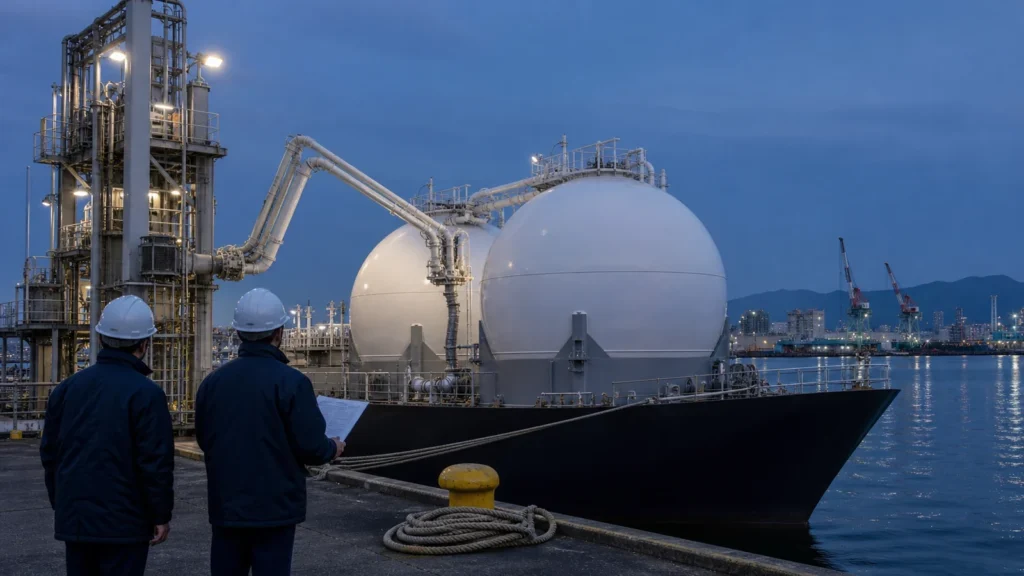
A carrier is the molecule I convert my hydrogen into for the voyage, and for now that mostly means ammonia or green ammonia. The IEA in the Global Hydrogen Review 2026 trade and infrastructure chapter records a result. Where a point of use requires pure hydrogen, shipping implies minimum costs of around 2 USD per kilogram. Energy use also stands above 10 kWh per kilogram in 2026, more than 30% of hydrogen’s energy content. The cause is liquefaction or reconversion, meaning the step of turning the carrier back into hydrogen, such as ammonia cracking.
Around 170 ammonia and 130 methanol port terminals are in operation in 2026. Also, the methanol side is being built out largely for bunkering, meaning the refuelling of ships. First shipments of low-emissions hydrogen are taking place in 2026, enabling trials of logistics and certification. Long-term bilateral contracts dominate, particularly for ammonia and ammonia-derived fertilisers.
What this means for you: my buyer may need pure hydrogen rather than the carrier as delivered. That 10 kWh per kilogram in 2026 lands on my margin unless the contract names who pays the reconversion.
What the two buyers have put in writing
Japan’s Basic Hydrogen Strategy of 2023, issued by METI, sets supply targets. It calls for up to 3 million tonnes per year by 2030. The 2040 target is 12 million tonnes per year, including ammonia. The 2050 target is about 20 million tonnes per year. Cost targets use the normal cubic metre, a volume at standard conditions. They are 30 yen in 2030 and 20 yen in 2050.
South Korea appears twice in that same document. Its roadmap of January 2019 targets 5.26 million tonnes per year by 2040 at 3 000 won per kilogram. Its vision of October 2021 targets 1 million tonne of clean hydrogen by 2030. That volume splits into 250 000 tonnes of green and 750 000 tonnes of blue. It tells me how much of that 2030 volume a molecule like mine could qualify for.
A target is not a delivered volume and a published cost figure is not a procurement price. Neither line commits a buyer to my molecules. The machinery that turns either into demand sits in the low carbon fuel mandates and in the contracts themselves.
What this means for you: I size against the target I can evidence a route into. I never write headline tonnage into a revenue model as contracted demand.
Where the flows would land
Hydrogen equivalent, written H2-eq, is the mass of hydrogen a cargo represents once converted. It lets me compare an ammonia freight rate with a hydrogen cost. The IRENA trade study of 2022 projects a result in its 1.5 C scenario. The study expects about one quarter of global hydrogen demand in international trade by 2050. That is 18.4 EJ per year, or around 150 Mt per year. Around 55% moves by pipeline and 45% by ship, mostly as ammonia.
The geography concentrates trade in a few countries. In that 2022 study Australia mainly supplies the Asian market while Europe takes 85% of pipeline trade. The top seven countries represent 96% of exports and 86% of imports. Ammonia shipping costs could fall from 8 to 0.8 USD per kilogram of hydrogen equivalent over 20 000 kilometres. That is a scenario value for 2050 rather than a quote I can book in 2026. Downstream demand decides where those cargoes aim, including the power to X and e fuels markets.
What this means for you: I locate my project against an import market that exists on paper for 2050. Its delivered cost exists only as a scenario, so I price the gap rather than assume it away.
What today's offtake market proves about demand
A firm contractual commitment is a signed obligation to take a defined volume, not an expression of interest. The IEA executive summary of the Global Hydrogen Review 2026 records two facts. New offtake agreements stayed broadly unchanged in 2025 at around 1.7 Mt. Only around 20% of newly signed volumes had firm contractual commitments in 2025.
For the first time, trade-oriented agreements overtook domestic-use agreements in 2025, thanks to policies in Japan. Also, the European Union’s announced supply for 2030 stands at 27 Mt in 2026. It is against just above 6 Mt of committed and strong-potential projects. I read that gap as the most useful demand signal I have. Also, it is why I work from the offtake agreement checklist I follow rather than from announcements.
What this means for you: I count a volume as demand only when it is firm. Also, everything else sits in a pipeline I track without booking revenue against it.
What public money underwrites, and what it does not
The IEA investment and innovation chapter of the same Global Hydrogen Review 2026 records a figure. International public finance in emerging economies reached around 3.3 billion USD in cumulative commitments to governments. The data runs to the first quarter of 2026. Project level funding stood at around 650 million USD at that same date. The shape matters: that money reaches a state budget before it reaches my project.
In 2026, over 85% of investment targets existing hydrogen uses in industry and refineries or hydrogen-based fuels. Also, capital spending on low-emissions hydrogen reached nearly 7 billion USD in 2025, nearly double the 2024 level. Public money therefore underwrites existing industrial demand first and an export chain second. Meanwhile, my own landed cost sits in the green hydrogen cost outlook for Southeast Asia in 2026.
What this means for you: I do not model support into my landed cost. First I have to name the policy and the disbursement trigger. The public finance recorded in early 2026 flows to governments before it flows to a producer.
What I put in the term sheet before I sign
Each of these four items moves my landed cost directly. Together they decide who absorbs the conversion loss. They also decide what emissions attribute I can claim at the far end and which party carries the last mile. Finally, they decide when I may reopen terms if policy moves underneath me. I write all four down before I discuss price.
- Conversion penalty: the energy I lose converting to the carrier and back, and the party paying for reconversion.
- Emissions boundary: the boundary the buyer’s scheme accepts, with the measurement method attached to the contract.
- Delivery point: where title and risk pass, and who pays the last leg to the buyer’s gate.
- Review points: price and volume reviews tied to policy implementation dates rather than calendar years.
What this means for you: with these four written down, the price I quote covers a defined chain. Any later disagreement becomes a review point rather than a renegotiation.
The order I work in
Around 80% of production with strong potential to 2030 targets chemicals, refining and low-emissions fuels in 2026. Therefore, the demand closest to my molecule is industrial and already sitting in existing plants. Against that, 22 Mt of announced potential could lose any chance of operating by 2030. Investment decisions have to be taken by early 2027. The window for my own chain is the same window as everyone else’s, and it is short.
What this means for you: I fix the carrier. Also, the emissions boundary first, then the delivery point and the review points, and only then do I price. I write the chain before I negotiate the number. A price agreed before the chain exists is a number nobody can deliver against. My file stays ready for the investment decisions that have to be taken by early 2027.
Sources
- IEA, Global Hydrogen Review 2026, Trade and infrastructure https://www.iea.org/reports/global-hydrogen-review-2026/trade-and-infrastructure, 2026.
- Japan METI, Basic Hydrogen Strategy https://www.meti.go.jp/shingikai/enecho/shoene_shinene/suiso_seisaku/pdf/20230606_5.pdf, 2023.
- IRENA, Global hydrogen trade to meet the 1.5 C climate goal: Part I, Trade outlook for 2050 and way forward https://www.irena.org/-/media/Files/IRENA/Agency/Publication/2022/Jul/IRENA_Global_hydrogen_trade_part_1_2022_.pdf, 2022.
- IEA, Global Hydrogen Review 2026, Executive summary https://www.iea.org/reports/global-hydrogen-review-2026/executive-summary, 2026.
- IEA, Global Hydrogen Review 2026, Investment and innovation https://www.iea.org/reports/global-hydrogen-review-2026/investment-and-innovation, 2026.
Frequently asked questions
What does Japan want to import by 2030?
Up to 3 million tonnes per year of hydrogen and ammonia supply by 2030, rising to 12 million tonnes per year by 2040 and about 20 million tonnes per year by 2050, with a cost target of 30 yen per normal cubic metre in 2030 (2023).
What does South Korea target for clean hydrogen?
1 million tonne of clean hydrogen by 2030, split into 250 000 tonnes of green and 750 000 tonnes of blue, and 5.26 million tonnes per year of supply by 2040 at 3 000 won per kilogram (2019, 2021, as recorded in 2023).
Is it economic to ship hydrogen to Asia today?
It can be, for carriers that travel as ammonia or methanol through existing terminals, but where the buyer needs pure hydrogen the shipping step alone implies at least 2 USD per kilogram and more than 10 kWh per kilogram, over 30% of the energy content (2026).
What should I check before signing an export term sheet?
The conversion penalty I carry, the emissions boundary the buyer’s scheme accepts, the delivery point and who pays the last leg, and review points tied to policy implementation, because only about 20% of newly signed volumes in 2025 were firm (2026).
Not sure your project would survive a credit conversation?
A short call is usually enough to see where your project stands.
If you are at the point where the chain is drafted and only the commercial terms remain, the offtake agreements work I do is exactly this: conversion penalty, emissions boundary, delivery point and review points, written into a document a buyer can actually sign.
I do not provide investment advice or arrange investments. I act as a strategic advisor and facilitator.

Alex, Founder of WeConnect Asia
I help low-carbon fuel and carbon removal project developers in Southeast Asia secure the commercial and financial partners needed to reach FID.
Related articles

Pitching a Climate Tech Company to Strategic Investors: What the Corporate Has to Believe Before It Writes a Cheque
How to pitch a climate tech company to strategic investors: the metric cluster, the readiness evidence and the ask that corporates fund.

Biomethane: What It Is, How It Is Made and Who Buys It
Biomethane is biogas cleaned to pipeline quality. I explain how it is made, how it differs from biogas and who buys it in Southeast Asia.

CO2 Sourcing for e-SAF Projects: What the Rules Allow and What the Contract Must Say
Biogenic CO2, direct air capture or industrial flue gas: which sources an e-SAF plant may use, what they cost and which contract terms make the fuel certifiable.

Operating Performance Guarantees for SAF Plants: What Lenders Ask For
Minimum guarantees, performance damages, retesting and who stands behind them: the operating guarantees a SAF plant needs to keep debt and offtake intact.

EPC and Construction Risk in SAF Plants: What a Lender Actually Tests
FEED scope, convertible EPC, performance guarantees and damages caps: the construction risk questions a SAF project must answer before financial close.

Matching Feedstock and Offtake Risk Back-to-Back in a SAF Project: How Lenders Read the Chain
Lenders do not buy a feedstock plan and an offtake plan separately. They buy the link between the two, and the link is where most SAF files break.