
Home » Reverse Water-Gas Shift and Co-Electrolysis: The CO2 to CO Step in PtL
Reverse Water-Gas Shift and Co-Electrolysis: The CO2 to CO Step in PtL
10 min read · Oct 5, 2025 · By Alex
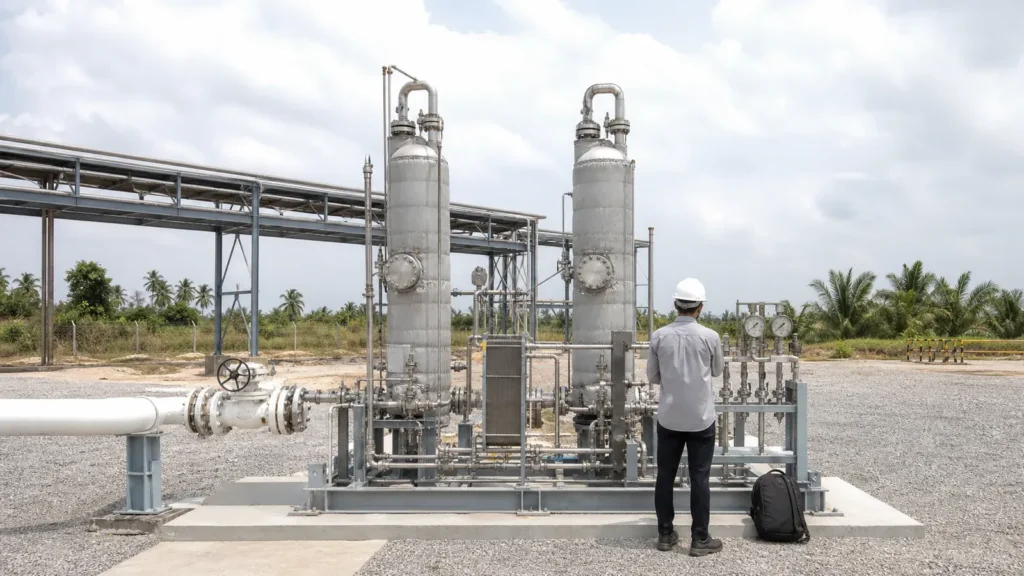
The Fischer-Tropsch reactor in a power-to-liquid plant needs carbon monoxide. Instead, The one-carbon molecule the liquid chain is built from, rather than carbon dioxide. Therefore, the plant either shifts the water gas reaction backwards in a separate vessel to turn CO2 into CO, or it feeds steam and carbon dioxide into one hotter cell so hydrogen and carbon monoxide come out together and the separate step disappears. Consequently, Those two options differ in hardware, in heat integration and in the element a lender will ask you to defend. Specifically, The first is the reverse water gas shift. By contrast, The water gas reaction run backwards so carbon dioxide and hydrogen give carbon monoxide and water. Furthermore, The second is high temperature co-electrolysis, one ceramic cell running hot enough to convert both feeds in one pass.
Reverse water gas shift: three questions first
In this power-to-liquid article I walk through why the CO has to be made, where the carbon comes from, and what the choice asks of the plant.
Before you commit, three questions need answers. By contrast, Why the conversion step exists at all, where the carbon atom comes from, and what each route asks of the plant in electricity, in heat and in maturity. In addition, I take them in that order.
In short
- The feed: Fischer-Tropsch synthesis consumes carbon monoxide, so CO2 has to be converted before any liquid is made.
- Two routes: the reverse water gas shift in its own reactor, or high temperature co-electrolysis in a single cell.
- Carbon origin: fossil combustion, a concentrated industrial stream, a concentrated renewable stream, or the open air.
- Maturity: in the 2016 table the route sits between 5 and 8 on the technology readiness level, a scale from lab proof to field demonstration.
- Efficiency: overall thermal efficiency from electricity to fuels is 40 to 60 percent, in 2023 figures.
In this article
What the reactor is actually given
The reactor is handed a mixture, not a raw emission. Meanwhile, As the 2016 assessment of power-to-liquid sets out, two production pathways sit behind that need: the Fischer-Tropsch route and the methanol route. Moreover, In the first, carbon monoxide and hydrogen form the mixture I call syngas, and Fischer-Tropsch synthesis, the chain-building reaction that turns one-carbon units into long liquid hydrocarbons, does the work. In the second, a carbon monoxide supply also has to be arranged. Consequently, Electrolysis gives hydrogen and nothing else, so no carbon atom arrives on its own.
The step earns its place because clean hydrogen and hydrogen-derived fuels could be vital for decarbonising shipping, aviation, long-haul trucks, iron and steel. Also, the chemical industries, which are the areas where other clean energy technologies cannot be easily deployed, as the 2020 analysis Batteries and hydrogen technology sets out. Instead, Electrolysers are, in plain terms, the devices that split water into hydrogen and oxygen using electrical energy.
What this means for you: I specify the CO supply as its own unit with its own duty, its own catalyst and its own guarantee, instead of letting the synthesis section quietly absorb it.
Where the carbon comes from
The carbon dioxide can come from the combustion of fossil fuels, from concentrated industrial streams such as cement, or from concentrated renewable sources such as biogas upgrading, sewage and ethanol plants, and the scale is easy to misread: replacing today’s global fossil kerosene demand of 2 600 million barrels a year with synthetic kerosene would require 1 Gt of CO2 a year, according to The Future of Hydrogen (2019). Furthermore, The origin of the carbon decides the climate result more than the reactor does.
Carbon dioxide can also be extracted from the air, and one 2016 study keeps a buffer storage with purification by liquefaction. Therefore, the capture unit runs when renewable power is plentiful.
What I ask the study is which stream, at what purity, under whose contract, and how the carbon capture and storage arrangement behaves when capture runs on surplus power.
What this means for you: I make the carbon source a named input with a stated purity, because the same reactor can be fed a green molecule or a fossil one.
The step that makes the CO
The Fischer-Tropsch reaction requires carbon monoxide as reactant instead of CO2, so in e-fuel applications a conversion step from CO2 to CO is needed before the synthesis. Therefore, The 2023 report The Role of E-fuels in Decarbonising Transport says it is achieved by catalysing the water gas shift reaction in reverse. Meanwhile, the hydrogen that accompanies it comes from water electrolysis. In addition, An alternative prepares syngas directly in a high temperature co-electrolysis of CO2 and hydrogen, which eliminates the need for a separate reverse water gas shift step.
In 2019, electrolyser systems ran at 60 percent to 81 percent efficiency depending on technology type and load factor, and around 9 litres of water are needed for 1 kg of hydrogen, with 8 kg of oxygen as a by-product.
The layout consequence is direct: one route adds a reactor vessel. Also, its own start-up sequence, the other adds a hot stack of ceramic cells and a tougher materials spec. In fact, I line both against green hydrogen production so the two bills are read together.
What this means for you: I ask the study to price both routes on one page, since the conversion step. Also, the electrolyser share one power balance and one water bill.
Where this step sits on the readiness ladder
In the 2016 readiness table of the German Environment Agency, the power-to-liquid route sits between 5 and 8, Fischer-Tropsch with low temperature electrolysis sits at 6 with the reverse water gas shift named as its critical element, Fischer-Tropsch with high temperature electrolysis sits at 5 with the solid oxide cell as critical element, and the methanol route with low temperature electrolysis sits at 8 with ASTM approval and final conversion as critical elements.
A solid oxide electrolysis cell is the ceramic cell that runs hot enough to take steam and carbon dioxide together and give hydrogen and carbon monoxide in one pass, which is what removes the separate reactor.
The same 2016 assessment judges the maturity of individual process steps far more advanced than commonly assumed, yet proof of concept of an integrated value chain from renewable electricity and CO2 to a refined product is still pending. A 2023 review still lists reverse water gas shift reactors among the components that need to be demonstrated at scale.
What this means for you: I write the critical element beside each readiness level, because the level shows the lender where the unresolved risk sits.
What comes out of the reactor
In 2016 figures, about 50 to 60 percent of the Fischer-Tropsch output suits jet fuel by energy, oligomerisation treats the C3 and C4 fraction so the fuel meets Jet A-1 specifications, and Fischer-Tropsch synthetic paraffinic kerosene is approved for blends of up to 50 percent with conventional jet fuel, so it is a blend component rather than a neat fuel.
The upgrading steps in that 2016 design are hydrocracking, which breaks heavy molecules into lighter ones, plus isomerisation and distillation, all used at large scale in oil refineries. In addition, In the high temperature case, waste heat of 220 to 250 degrees Celsius from the exothermic Fischer-Tropsch synthesis is reused to raise steam, lowering the cell’s electricity demand.
In 2023 figures, electrolysers run at 65 to 70 percent efficiency and the downstream synthesis step at 65 to 85 percent. Therefore, overall thermal efficiency from electricity to fuels is 40 to 60 percent. Furthermore, What reaches the airport is a drop-in fuel, one that replaces the conventional product in the existing engine, pipeline and wing without change. Also, the quality case sits with the sustainable aviation fuel discussion.
What this means for you: I put jet share, approved blend ceiling and efficiency range in one table. Therefore, nobody reads a 50 percent blend as permission to fuel neat.
What I ask a study to prove
First, whether the reverse reactor is included in the case or the co-electrolysis route is chosen. Moreover, In one 2016 study the co-electrolysis option was set aside as subject to further research. Moreover, This means the conservative case in a model is not the same case in a design.
Second, whether the heat integration that lets the high temperature route reuse synthesis heat is modelled at part load, since a plant that spends its life away from its design point will not see all the heat it was promised on paper.
Third, which of the two routes the plant will defend when the lender asks for the critical element, because a 2023 review still lists reverse water gas shift reactors among the components that need to be demonstrated at scale, so design route and demonstration route have to be one and the same.
What this means for you: each of these three checks changes a number the lenders will read, so I settle them in the technical review before the model is frozen.
What the money sees
In the 2030 airline ticket cost model of the Global Hydrogen Review 2026, fossil kerosene is carried at 28 USD per GJ and synthetic kerosene at 163 USD per GJ. Therefore, The same 2026 review finds that most of the industrial sector across regions accepts a maximum hydrogen cost of 1 to 4 USD per kg, driven largely by carbon pricing, and that without carbon pricing the acceptable maximum for steel would be negative across all regions.
On the capital side, 2023 cost assumptions carry a chain of reverse water gas shift reactor, Fischer-Tropsch synthesis and refinery at 1 200 USD per kilowatt electric, with carbon dioxide feedstock at 30 USD per tonne.
That spread is where the conversion step gets argued about, because the reactor is a small share of a large number while the fuel it enables is priced against a kerosene assumption it cannot move.
What this means for you: I present the step as a capital line and an efficiency penalty against a fuel price spread, read with the power-to-liquid investing logic in front of me.
The three lines I write in the feasibility note
Everything above has to collapse into a note a lender can read in one sitting, before the technical questions start. I keep this step to three lines, because more than three and nobody quotes them back to me.
Line one: which route supplies the carbon monoxide and what its critical element is, written with the 2016 readiness table open in front of me rather than from memory.
By contrast, Line two: who owns the carbon dioxide supply and at what purity it is delivered, including whether the feed is buffered and purified, as one 2016 design assumed.
Line three: what efficiency penalty the route costs at the plant gate, taken from the 2023 overall range of 40 to 60 percent rather than from a component datasheet.
What this means for you: three lines, three owners, three numbers I can defend in a room, and any one of them missing tells me the study has not yet chosen a route.
Sources
- IEA, The Future of Hydrogen https://iea.blob.core.windows.net/assets/9e3a3493-b9a6-4b7d-b499-7ca48e357561/The_Future_of_Hydrogen.pdf, 2019.
- IEA, Global Hydrogen Review 2026 https://iea.blob.core.windows.net/assets/af4b6218-0311-4963-91ab-903cb18ca0ca/GlobalHydrogenReview2026.pdf, 2026.
- IEA, The Role of E-fuels in Decarbonising Transport https://iea.blob.core.windows.net/assets/9e0c82d4-06d2-496b-9542-f184ba803645/TheRoleofE-fuelsinDecarbonisingTransport.pdf, 2023.
- German Environment Agency, Power-to-Liquids: Potentials and Perspectives for the Future Supply of Renewable Aviation Fuel https://www.bauhaus-luftfahrt.net/fileadmin/user_upload/Publikationen/161005_uba_hintergrund_ptl_barrierrefrei.pdf, 2016.
- IEA, Batteries and hydrogen technology: keys for a clean energy future https://www.iea.org/articles/batteries-and-hydrogen-technology-keys-for-a-clean-energy-future, 2020.
Frequently asked questions
Why can't the Fischer-Tropsch reactor take CO2 directly?
The reaction builds its carbon chain from carbon monoxide units, not from carbon dioxide, so feeding CO2 straight in would leave you with no chain to build. The molecule has to be converted first, either by running the water gas reaction backwards or by generating it directly in a hot cell. That conversion is the step this whole article is about.
What is the difference between reverse water gas shift and co-electrolysis?
One uses an extra reactor and a catalyst to turn carbon dioxide plus hydrogen into carbon monoxide plus water, with the hydrogen supplied separately by electrolysis. The other does the work in a single solid oxide electrolysis cell, giving hydrogen and carbon monoxide together and removing the separate reactor. The first is a bolt-on unit; the second changes the plant’s heat balance and materials spec.
Which of the two routes is more mature today?
The 2016 readiness table puts Fischer-Tropsch with low temperature electrolysis at level 6 with the reverse water gas shift as its critical element, and Fischer-Tropsch with high temperature electrolysis at level 5 with the solid oxide cell as critical element. On those numbers the separate reactor carries the higher readiness of the two, and neither route yet has a full integrated demonstration behind it.
What should a feasibility study show about this step?
It should name the chosen route and its critical element, identify the carbon dioxide supply with its purity and its contract, give the efficiency penalty at the plant gate, and show the heat integration at part load rather than at design point only. I also want the demonstration package identified, because a component that still needs scale is a schedule risk.
Not sure your project would survive a credit conversation?
A short call is usually enough to see where your project stands.
If this step is what is blocking your study, I offer technology maturity and scale up support covering the route choice, the critical element and the demonstration package, worked through with your study team while the numbers are still movable.
I do not provide investment advice or arrange investments. I act as a strategic advisor and facilitator.

Alex, Founder of WeConnect Asia
I help low-carbon fuel and carbon removal project developers in Southeast Asia secure the commercial and financial partners needed to reach FID.
Related articles

Pitching a Climate Tech Company to Strategic Investors: What the Corporate Has to Believe Before It Writes a Cheque
How to pitch a climate tech company to strategic investors: the metric cluster, the readiness evidence and the ask that corporates fund.

Biomethane: What It Is, How It Is Made and Who Buys It
Biomethane is biogas cleaned to pipeline quality. I explain how it is made, how it differs from biogas and who buys it in Southeast Asia.

CO2 Sourcing for e-SAF Projects: What the Rules Allow and What the Contract Must Say
Biogenic CO2, direct air capture or industrial flue gas: which sources an e-SAF plant may use, what they cost and which contract terms make the fuel certifiable.

Operating Performance Guarantees for SAF Plants: What Lenders Ask For
Minimum guarantees, performance damages, retesting and who stands behind them: the operating guarantees a SAF plant needs to keep debt and offtake intact.

EPC and Construction Risk in SAF Plants: What a Lender Actually Tests
FEED scope, convertible EPC, performance guarantees and damages caps: the construction risk questions a SAF project must answer before financial close.

Matching Feedstock and Offtake Risk Back-to-Back in a SAF Project: How Lenders Read the Chain
Lenders do not buy a feedstock plan and an offtake plan separately. They buy the link between the two, and the link is where most SAF files break.