
Home » Liquid Hydrogen and Hydrogen Carriers: LOHC and Ammonia Compared
Liquid Hydrogen and Hydrogen Carriers: LOHC and Ammonia Compared
10 min read · Sep 11, 2025 · By Alex
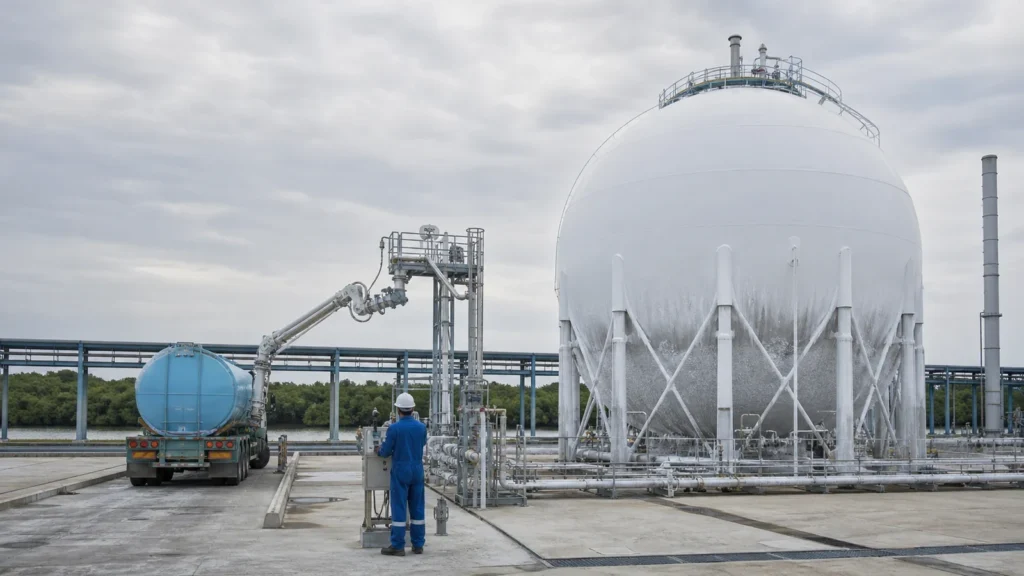
Below about 1 500 km I move the molecule as a gas by pipeline. Above that distance I move it as ammonia or in a liquid organic hydrogen carrier. Converting hydrogen into ammonia costs around 1 USD per kg of H2 in 2019. You pay the return conversion again in 2026. Shipping to a buyer who needs pure hydrogen implies at least 2 USD per kg of H2. It also costs more than 10 kWh per kg in 2026, over 30 percent of what the molecule carries. These are the hydrogen carriers I compare here, next to liquefied hydrogen itself. You pay the charge twice on every one. For a project built on green hydrogen, the wrapper decision arrives before the cost model. It sets what your buyer receives at the dock.
The hydrogen carrier decision in seven moves
I set out the decision in what follows. I start with what a carrier is in plain words, then the distance rule that picks the vector. Next I take what shipping adds when your buyer wants pure molecules. Then I look at what is already at the dock in this region. After that I weigh what the choice does to the cost model. I hold two things back for last: what I treat as firm and what I treat as a plan. Then come the lines I put in the term sheet.
In short
- Distance: below about 1 500 km in 2019 the gas pipeline is the cheapest delivery option. Above it, ammonia or an organic carrier by ship takes over.
- Conversion: turning hydrogen into ammonia costs around 1 USD per kg of H2 in 2019. The carrier takes a charge for the way back out again in 2026.
- Energy: every shipping pathway needs more than 10 kWh per kg in 2026, over 30 percent of the energy content.
- Dock: a Singapore data centre user signed a conditional offtake for clean liquid hydrogen in October 2024. They take delivery of volumes starting in 2030.
- Contract: cumulative firm offtake agreements sit at less than 2 Mtpa in 2025. The share is about 5 percent of what announced projects could reach by 2030.
In this article
What a carrier actually is
Vocabulary first, because the decision turns on nine words. A carrier is a wrapper molecule that borrows the hydrogen and hands it back at the other end. A liquid organic hydrogen carrier is an organic liquid that absorbs and releases hydrogen. Meanwhile, ammonia carries hydrogen and nitrogen together as one carrier. Liquefaction is the step that cools hydrogen until it becomes a liquid that fits in a tank. Ammonia cracking and dehydrogenation move the hydrogen back out at the import end. My word for that return trip is reconversion. Boil-off is the slow evaporation of a cryogenic cargo while it waits, and whoever owns the tank carries it. Delivered cost is what lands at your buyer’s gate per kilogram, conversion and voyage included. Also, an offtake is the contract under which your buyer takes the volume.
The molecule never changes across these steps, only the wrapper does. As a result, you pay twice for every wrapper, once out and once back.
What this means for you: I price the wrapper before I price the molecule. In fact, both conversion charges hide in the wrapper, and you pay them there.
The distance rule that picks the vector
In The Future of Hydrogen the boundary sits at about 1 500 km: below it. Moving hydrogen as a gas by pipeline is still likely the cheapest option once you count capital and operating costs. Above it, shipping as ammonia or in a liquid organic hydrogen carrier was more cost-effective, in 2019. The costs follow that line, because converting hydrogen into ammonia costs around 1 USD per kg of H2. Therefore, transmitting ammonia over 1 500 km costs around 1.5 USD per kg of H2, in 2019. At 2 500 km an ammonia pipeline including conversion stays broadly similar to hydrogen gas. Specifically, the cost is around 2 USD per kg of H2 in 2019.
Ship cargo over 1 500 km costs 0.6 USD per kg of H2 in an organic carrier, conversion included. By contrast, the same trip costs 1.2 USD as ammonia and 2 USD as liquid hydrogen in 2019. Overseas shipments generally mean liquefying the molecule, or moving it as ammonia or an organic carrier. Before the choice enters my model I check the maturity and scale up status of each conversion step.
What this means for you: I argue for the pipeline under 1 500 km. Above it I hold the two ship cargoes against each other. Then I test the conversion step, and maturity shows its limits.
What shipping adds when the buyer needs pure hydrogen
The Global Hydrogen Review 2026 is blunt about the return trip. Shipping implies at least 2 USD per kg of H2 wherever the point of use needs pure hydrogen. The route also needs more than 10 kWh per kg, over 30 percent of the energy content. The cause is intensive liquefaction or reconversion such as ammonia cracking, all in 2026. Every shipping pathway needs more than 10 kWh per kg in 2026, while pipelines have the lowest energy requirements. The heat input for ammonia cracking and for dehydrogenation of an organic carrier sits at the import end. Therefore, your buyer pays for it. Pipelines remain the lowest-cost option for pure hydrogen where routes and high utilisation rates exist in 2026. Meanwhile, shipping buys sourcing flexibility and uses some existing port infrastructure in 2026.
I split that for your buyer: green ammonia moves easily at scale and then has to be cracked. Liquid hydrogen keeps the molecule pure and charges for it in energy.
What this means for you: I ask one question: does your buyer need the molecule or the carrier? Consequently, the answer sets the conversion charge and the energy bill at the dock.
What is at the dock in this region
The APERC Hydrogen Report 2024 records the dock in this region. In October 2024 a Singapore data centre user signed a conditional offtake to ship clean liquid hydrogen from 2030. In May 2024 trials ran on liquid ammonia blended with diesel and hydrotreated vegetable oil. A vessel in the Port of Singapore staged the trials. A 600 MW hydrogen-ready plant on Jurong Island starts on natural gas blended with 30 percent hydrogen. It has planned a move to 100 percent hydrogen since 2024. In November 2024 parties signed an agreement for a pipeline of 100 000 tonnes of hydrogen per year. The pipeline moves hydrogen from Sumatra, the Riau Islands and Singapore to feed a 600 MW turbine. Moreover, it complements a 340 MW open-cycle turbine announced in 2023.
Around 170 ammonia terminals and 130 methanol terminals are in operation in 2026. Ammonia leads among announced projects, while more methanol infrastructure is under construction mainly for bunkering in 2026. Meanwhile, construction has started in Japan on the first commercial-scale terminal for liquefied hydrogen imports. None of that is booked for you, so I read the liquid routes with the power to liquid path.
What this means for you: I count only operating and committed capacity as a dock. I hold every conditional contract as a schedule with a risk flag.
Why the vector shows up in your cost model
Batteries and hydrogen technology explains why the wrapper costs what it costs. Batteries and electrolysers both move electricity into chemical energy and back. They keep the same electrochemistry, materials and manufacturing processes. Battery costs have moved further, while electrolyser manufacturing sits at an earlier stage. This leaves more room for near-term cost cuts in 2020. Clean hydrogen and hydrogen-derived fuels can be decisive in hard-to-deploy sectors. Other clean energy technologies do not deploy easily in shipping, aviation, long-haul trucks, iron and steel and chemicals. In fact, I carry that logic into my own model. The vector sets the conversion line, the voyage line and the energy line. Also, all three land in the price I can quote per kilogram delivered. Change the vector and the same production cost arrives at a different delivered cost.
Therefore, I never price the molecule before I pick the wrapper against my green hydrogen cost baseline for Southeast Asia.
What this means for you: The vector is a line item in the price you quote, not a footnote. I cost it before your buyer sees the number.
What I treat as firm and what I treat as a plan
Specifically, announced terminals and announced shipping capacity are not operating capacity in 2026. Less than 8 percent of the tradable volume comes from projects that are operational or under construction. Close to 1 Mtpa in hydrogen equivalent comes from projects that reached FID, in 2026. Across the whole project pipeline to 2030 the figure is around 16 percent, in 2026. Announced hydrogen pipeline projects exceed 40 000 km by 2035 in 2026. Meanwhile, only 9 percent of that length is operational, under construction or committed in 2026. I keep two columns on my screen: one for capacity that exists, one for announced capacity. I never let the announced column fill a line in the cost model. A terminal operator or a shipping line may tell me that a slot exists. I then ask which of the three categories it sits in, before it enters the model.
What this means for you: I book from the committed column only. I write the announced column as a schedule with a risk flag, never as a volume you can sell.
What I put in the term sheet
The Global Hydrogen Review 2025 sets out the demand problem. Cumulative firm offtake agreements sit at less than 2 Mtpa in 2025. The figure is about 5 percent of the production that announced projects could reach by 2030. I take the buyer first, or I take a carrier for nobody. The primary barrier is the cost gap between low-emissions hydrogen and conventional fossil-based alternatives. The gap sits in refining, steel, shipping and aviation, in 2025. In emerging economies capital costs can reach 15 percent, three times the level of advanced economies, in 2025. Fully 80 percent of those projects depend on exports, in 2025. That is why I draft the clauses with my checklist for securing an offtake open in front of me: molecule specification, energy penalty paid by whom, terminal slot committed, and volume covered by firm demand.
What this means for you: I pick the buyer first and the carrier second. A wrapper with no firm demand behind it is a wrapper you pay for twice, with nobody waiting.
The five lines I write before I sign
Five lines sit in the term sheet before I sign. First, the distance band sets the vector in 2019. Second, the conversion charged twice in 2019. Third, the energy penalty the buyer pays for on delivery in 2026. Fourth, the committed share of the terminal and the line you rely on in 2026. Fifth, the firm demand that covers the cargo in 2025.
I then set the whole file down to one rule. Then you take the carrier from the distance band and your buyer’s specification. You price the two conversions and the energy penalty. Last you check that committed capacity and firm demand cover the cargo. I do not sign when any one of the five lines is empty. You pay for the wrapper twice, whatever the brochure says. This is the method I hand a developer in feasibility. Also, it holds whatever the destination, the season or the price of the molecule.
What this means for you: I walk in with five lines, one distance band and one firm buyer. I sign only after I write all five down.
Sources
- IEA, The Future of Hydrogen https://iea.blob.core.windows.net/assets/9e3a3493-b9a6-4b7d-b499-7ca48e357561/The_Future_of_Hydrogen.pdf, 2019.
- IEA, Global Hydrogen Review 2026 https://iea.blob.core.windows.net/assets/af4b6218-0311-4963-91ab-903cb18ca0ca/GlobalHydrogenReview2026.pdf, 2026.
- IEA, Global Hydrogen Review 2025, Five key questions about hydrogen https://www.iea.org/reports/global-hydrogen-review-2025/five-key-questions-about-hydrogen, 2025.
- IEA, Batteries and hydrogen technology: keys for a clean energy future https://www.iea.org/articles/batteries-and-hydrogen-technology-keys-for-a-clean-energy-future, 2020.
- Asia Pacific Energy Research Centre, APERC Hydrogen Report 2024 https://aperc.or.jp/file/2025/3/18/APERC_Hydrogen_Report_2024_final.pdf, 2025.
Frequently asked questions
What is the cheapest way to export hydrogen?
Below about 1 500 km the gas pipeline is the cheapest delivery option, at around 1 USD per kg of H2 in 2019 once capital and operating costs are counted. Beyond that distance ammonia or an organic carrier by ship wins: conversion plus transport over 1 500 km comes to around 1.2 USD per kg of H2 as ammonia and 0.6 USD per kg of H2 in an organic carrier in 2019.
Why does ammonia keep showing up as a hydrogen carrier?
Because it is easier to move than pure hydrogen at scale. Converting hydrogen into ammonia costs around 1 USD per kg of H2 and transmission over 1 500 km brings the total to around 1.5 USD per kg of H2 in 2019, while around 170 ammonia terminals are already in operation in 2026, so the port side exists before your cargo does.
How much energy is lost when hydrogen is shipped?
Every shipping pathway needs more than 10 kWh per kg of H2 in 2026, over 30 percent of the energy content, and where pure hydrogen is needed at the point of use the shipping cost alone implies a minimum of around 2 USD per kg in 2026. Pipelines carry the lowest energy requirement, and the heat for cracking or dehydrogenation sits at your buyer’s end.
Should I sign a liquid hydrogen contract today?
Construction has started in Japan on the first commercial-scale terminal for liquefied hydrogen imports in 2026, and in this region a conditional supply contract to Singapore starts only in 2030, signed in 2024. Firm capacity and a firm buyer still come first, so I would not sign today on the strength of announced terminals and announced shipping slots in 2026.
Not sure your project would survive a credit conversation?
A short call is usually enough to see where your project stands.
If you want a second read on the vector before the cost model and the term sheet freeze, I offer technology maturity and scale-up support for exactly this decision.
I do not provide investment advice or arrange investments. I act as a strategic advisor and facilitator.

Alex, Founder of WeConnect Asia
I help low-carbon fuel and carbon removal project developers in Southeast Asia secure the commercial and financial partners needed to reach FID.
Related articles

Pitching a Climate Tech Company to Strategic Investors: What the Corporate Has to Believe Before It Writes a Cheque
How to pitch a climate tech company to strategic investors: the metric cluster, the readiness evidence and the ask that corporates fund.

Biomethane: What It Is, How It Is Made and Who Buys It
Biomethane is biogas cleaned to pipeline quality. I explain how it is made, how it differs from biogas and who buys it in Southeast Asia.

CO2 Sourcing for e-SAF Projects: What the Rules Allow and What the Contract Must Say
Biogenic CO2, direct air capture or industrial flue gas: which sources an e-SAF plant may use, what they cost and which contract terms make the fuel certifiable.

Operating Performance Guarantees for SAF Plants: What Lenders Ask For
Minimum guarantees, performance damages, retesting and who stands behind them: the operating guarantees a SAF plant needs to keep debt and offtake intact.

EPC and Construction Risk in SAF Plants: What a Lender Actually Tests
FEED scope, convertible EPC, performance guarantees and damages caps: the construction risk questions a SAF project must answer before financial close.

Matching Feedstock and Offtake Risk Back-to-Back in a SAF Project: How Lenders Read the Chain
Lenders do not buy a feedstock plan and an offtake plan separately. They buy the link between the two, and the link is where most SAF files break.