
Home » Methanol Synthesis for PtL: What This Route Asks of My Plant
Methanol Synthesis for PtL: What This Route Asks of My Plant
10 min read · Sep 29, 2025 · By Alex
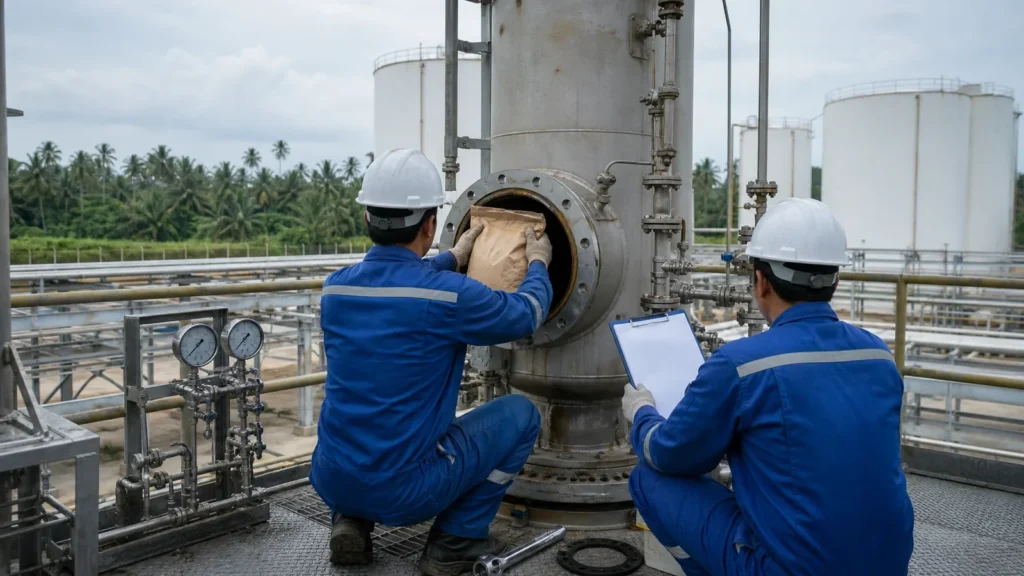
Power-to-liquid is the route that makes liquid fuel from renewable hydrogen and captured CO2, and one of its two finishing paths runs through methanol. In that path, methanol synthesis in a power-to-liquid plant takes CO2, or a mix of CO and CO2, plus renewable hydrogen over a copper catalyst at 200 to 300 degrees Celsius and 50 to 100 bar, as reported in 2021. Methanol synthesis ptl therefore rests on a step rated at readiness level 8 to 9 that needs no reverse water gas shift reactor. What it does not yet deliver is jet fuel: none has been produced through this pathway and approval under ASTM D7566 was pending in 2016. The wider branch above this loop is power-to-liquid.
I walk the loop in the order I would defend it to a bank: the reaction itself, what has to arrive at its inlet, what it removes from my process, and what the hydrogen, carbon and money still ask of the plant. The last part is also where the route stops short.
In short
- Reaction: Copper based catalysis at 200 to 300 degrees Celsius and 50 to 100 bar, rated at readiness level 8 to 9 in 2021.
- Feed: Captured CO2 or a CO and CO2 mix with renewable hydrogen, so no reverse water gas shift reactor is required.
- Carbon: Direct air capture or biogenic off-gases both feed the loop, and the choice fixes my carbon cost for the life of the plant.
- Limits: No jet fuel has come out of this pathway, and ASTM D7566 approval for it was still pending in 2016.
- Money: Low-emissions hydrogen projects drew nearly 7 billion USD of capital spending in 2025.
In this article
What the loop actually does
Methanol synthesis is the catalytic step that turns a feed of CO and CO2 plus renewable hydrogen into methanol, and it is the part of my power-to-liquid design that behaves like a process the chemical industry has run for decades. A catalyst speeds a reaction without being consumed, and here the traditional material is built from copper, zinc and aluminium oxide. In 2021 that catalyst needed only a slight modification to absorb the extra water the reaction produces, catalysts able to run under milder conditions were already under development, and the operating window stood at 200 to 300 degrees Celsius and 50 to 100 bar.
Two terms then govern my sizing. Syngas is the conditioned gas feed that reaches the reactor, and reverse water gas shift is the CO2 to CO conversion this route can avoid, because the methanol reaction accepts both CO and CO2 at once.
What this means for you: I am sizing a loop whose core step is the calmest item in my whole package, so I can spend my diligence budget on the feedstock contract and the power supply instead of on the reactor chemistry.
What goes into the loop
The product I am sizing is described in the green methanol route, and IRENA and the Methanol Institute record in 2021 that e-methanol, meaning methanol made from captured CO2 and renewable hydrogen, comes from a single catalytic process. That same 2021 record shows the CO2 can come from the atmosphere directly through direct air capture, which means pulling CO2 out of ambient air, or through biomass.
The cheaper carbon is biogenic carbon, meaning carbon that recently passed through living matter. The 2021 record lists distilleries, fermentation units, municipal solid waste and biogas units as normally treated as off-gases and vented, and it names the capture of that CO2 as bioenergy with carbon capture and storage.
The hydrogen side sets a scale problem: in 2021, replacing a conventional methanol plant of 2 500 tonnes per day required an electrolyser in the gigawatt range, and production capacity for electrolysers that large still needed to be developed.
What this means for you: I can usually secure carbon cheaper than air, but I have to prove the off-gas contract lasts as long as the plant, and I have to accept that an electrolyser on the scale of a mega-methanol plant is not a catalogue purchase.
What this route does not require
The German Environment Agency set out in 2016 that the methanol synthesis reaction accepts both CO and CO2, so a reverse water gas shift process or a co-electrolysis step is not a necessity on this route, unlike on the Fischer-Tropsch path. That deletes a whole reactor island from my front end.
It does not delete the back end. Converting methanol to jet fuel and other hydrocarbons takes several steps, notably DME synthesis, olefin synthesis, oligomerization and hydrotreating, and those steps are used at large scale in refineries today. The product they would release is a drop-in fuel, meaning one that swaps into existing engines and infrastructure without modification. What is missing is the record: in 2016 no jet fuel had been produced via the methanol pathway, and technical approval of that pathway under ASTM D7566 was pending. The carbon inlet sits behind carbon capture and storage rules either way.
What this means for you: I gain a simpler front end and inherit a fuel approval problem at the back, so I only place jet fuel inside my scope when a buyer is prepared to carry the certification risk alongside me.
What the hydrogen and power side has to deliver
The IEA e-fuels report of 2023 put large-scale commercial electrolysers at 65 to 70 percent efficiency on a lower heating value basis, and the downstream synthesis step at 65 to 85 percent depending on the end product, which puts overall thermal efficiency from electricity to fuels at 40 to 60 percent. In the same 2023 modelling, hydrogen converted to methanol runs at 80 percent.
Load factor then decides the bill. In 2023, the levelised cost of e-fuels starts to rise very quickly once the plant load factor drops below 40 percent, and at an electricity price of 50 USD per MWh the power alone contributes 25 to 35 USD per gigajoule of finished fuel, before any capital or consumable is counted. My hydrogen feed comes from green hydrogen supply, and its price is only one line of that total.
What this means for you: I treat the load factor as a contractual input rather than an assumption, because the gap between a stable power agreement and a cheap one decides whether this loop closes at all.
What the carbon source decides downstream
The IEA direct air capture report of 2022 counted 18 direct air capture facilities operating in Canada, Europe and the United States, with the first large-scale plant of up to 1 Mt CO2 per year in advanced development in 2022. For a large-scale plant built at that time, capture cost estimates ran between 125 and 335 USD per tonne of CO2.
That cost sits directly inside my methanol synthesis ptl number, which is why the inlet choice matters more to me than the reactor. The same 2022 report treated air-captured CO2 as a climate-neutral feedstock for products needing a source of carbon, from chemicals to synthetic aviation fuels, and its Net Zero scenario put around 350 Mt of air-captured CO2 into synthetic fuels in 2050, a scenario value rather than a delivery.
Methanol also lands without conversion in the marine outlet, described under the maritime fuel route.
What this means for you: I fix the carbon source first because it drives delivered cost and certification, and I only pay for air capture when the biogenic option cannot cover the tonnage I need.
What the money has decided so far
The IEA Global Hydrogen Review 2026 reported that capital spending on low-emissions hydrogen projects reached nearly 7 billion USD in 2025, nearly double the 2024 level and equal to 0.7 percent of global investment in energy supply. It also reported that over 85 percent of that investment targets existing hydrogen uses in industry and refineries or hydrogen-based fuels.
Venture capital moved the opposite way, falling from a 13 percent peak in 2023 to 4 percent in 2025, with aviation attracting almost 25 percent of hydrogen venture capital in 2025. The same 2026 review states that hydrogen use in industry and synthetic hydrocarbons is only now moving to first-of-a-kind projects, more slowly than modular end-use sectors such as transport. I use my checklist before a final investment decision to test whether my package reads as one of those slow movers.
What this means for you: I read the money as a sequencing warning, because my project sits in the slowest-moving category and the file has to survive a lender’s review, not only an engineering one.
How I decide for a specific project
- Whether my buyer needs methanol as a fuel or as a chemical feedstock, because those two markets pay differently and certify differently.
- Which CO2 source I can contract for the life of the plant, biogenic off-gas, biomass route or air capture.
- Whether the downstream conversion steps to jet fuel sit inside my scope or inside the buyer’s.
- What load factor my power contract can sustain once curtailment and grid constraints are applied.
On the evidence available in 2016, the efficiency difference between the Fischer-Tropsch route and the methanol route was negligible, so efficiency is not the variable that decides this choice. What decides it is the maturity of the synthesis step, which was already at readiness level 8 to 9 in 2021, weighed against a jet fuel approval that remained pending in 2016. Where my buyer wants methanol as a chemical or as a marine fuel rather than as jet fuel, that mature step is enough for me to select the route and carry it forward despite the pending approval.
What this means for you: I choose this route when the product is methanol itself and the carbon and power are contracted, and I hold it back only when the business case depends on jet fuel.
The order I work in
In 2021 methanol production stood at about 98 Mt per year against less than 0.2 Mt of renewable methanol produced annually, so almost everything on the market was fossil. In 2023 modelling, the cost of direct air capture carbon was set between 400 and 670 USD per tonne, a figure I have to carry for as long as I rely on air.
I fix the product first, then the carbon source, then the power contract, then the downstream scope. I do not price the reactor before those three are written down. Only then do I hand the package to a feasibility study.
What this means for you: I sequence the work so that every later number is anchored to a contract rather than to a hope, and I start with the molecule your buyer actually signs for.
Sources
- German Environment Agency, Power-to-Liquids: Potentials and Perspectives for the Future Supply of Renewable Aviation Fuel https://www.bauhaus-luftfahrt.net/fileadmin/user_upload/Publikationen/161005_uba_hintergrund_ptl_barrierrefrei.pdf, 2016.
- IRENA and Methanol Institute, Innovation Outlook: Renewable Methanol https://www.irena.org/-/media/Files/IRENA/Agency/Publication/2021/Jan/IRENA_Innovation_Renewable_Methanol_2021.pdf, 2021.
- IEA, The Role of E-fuels in Decarbonising Transport https://iea.blob.core.windows.net/assets/9e0c82d4-06d2-496b-9542-f184ba803645/TheRoleofE-fuelsinDecarbonisingTransport.pdf, 2023.
- IEA, Direct Air Capture: A key technology for net zero https://iea.blob.core.windows.net/assets/78633715-15c0-44e1-81df-41123c556d57/DirectAirCapture_Akeytechnologyfornetzero.pdf, 2022.
- IEA, Global Hydrogen Review 2026, Investment and innovation https://www.iea.org/reports/global-hydrogen-review-2026/investment-and-innovation, 2026.
Frequently asked questions
What is methanol synthesis in a power-to-liquid plant?
It is the catalytic step that turns a feed of CO and CO2 plus renewable hydrogen into methanol, run between 200 and 300 degrees Celsius and 50 to 100 bar over a copper, zinc and aluminium oxide catalyst. The step itself sat at readiness level 8 to 9 in 2021, with catalysts able to work under milder conditions under development. Syngas, the conditioned gas feed, arrives already prepared, so I size the loop around compression and the water balance rather than around a new chemistry.
Does this route need a reverse water gas shift reactor?
No, because both CO and CO2 can be fed to methanol synthesis, so the reverse water gas shift or co-electrolysis step that the other power-to-liquid pathway needs is not a necessity, as established in 2016. The practical saving is a reactor island at the front of the plant, plus the capital and operating attention that island would demand.
Is e-methanol approved as jet fuel?
No, no jet fuel has yet been produced through this pathway and technical approval under ASTM D7566 was pending in 2016, even though the individual process steps, from DME synthesis through olefin synthesis, oligomerization and hydrotreating, are used at large scale in refineries today. Methanol sold as a chemical or as a road and maritime fuel does not carry that constraint.
How do I start for my own project?
I fix the product my buyer needs, then the CO2 source I can contract for the plant life, then the downstream conversion steps inside my scope, and finally the load factor my power contract sustains, in that order, working from the 2021 process record and the 2023 cost modelling. I do not start with the reactor, because the reactor is the part already decided.
Not sure your project would survive a credit conversation?
A short call is usually enough to see where your project stands.
If you are standing at the same junction, I offer technology maturity and scale up support to test readiness, scope and scale-up exposure before you commit to a feasibility study. Bring the feed data and the power offer and I will walk the loop with you.
I do not provide investment advice or arrange investments. I act as a strategic advisor and facilitator.

Alex, Founder of WeConnect Asia
I help low-carbon fuel and carbon removal project developers in Southeast Asia secure the commercial and financial partners needed to reach FID.
Related articles

Pitching a Climate Tech Company to Strategic Investors: What the Corporate Has to Believe Before It Writes a Cheque
How to pitch a climate tech company to strategic investors: the metric cluster, the readiness evidence and the ask that corporates fund.

Biomethane: What It Is, How It Is Made and Who Buys It
Biomethane is biogas cleaned to pipeline quality. I explain how it is made, how it differs from biogas and who buys it in Southeast Asia.

CO2 Sourcing for e-SAF Projects: What the Rules Allow and What the Contract Must Say
Biogenic CO2, direct air capture or industrial flue gas: which sources an e-SAF plant may use, what they cost and which contract terms make the fuel certifiable.

Operating Performance Guarantees for SAF Plants: What Lenders Ask For
Minimum guarantees, performance damages, retesting and who stands behind them: the operating guarantees a SAF plant needs to keep debt and offtake intact.

EPC and Construction Risk in SAF Plants: What a Lender Actually Tests
FEED scope, convertible EPC, performance guarantees and damages caps: the construction risk questions a SAF project must answer before financial close.

Matching Feedstock and Offtake Risk Back-to-Back in a SAF Project: How Lenders Read the Chain
Lenders do not buy a feedstock plan and an offtake plan separately. They buy the link between the two, and the link is where most SAF files break.